Mark 1:21-28 New Living Translation… Jesus and his companions went to the town of Capernaum. When the Sabbath day came, he went into the synagogue and began to teach. 22 The people were amazed at his teaching, for he taught with real authority—quite unlike the teachers of religious law.
23 Suddenly, a man in the synagogue who was possessed by an evil spirit cried out, 24 “Why are you interfering with us, Jesus of Nazareth? Have you come to destroy us? I know who you are—the Holy One of God!”
25 But Jesus reprimanded him. “Be quiet! Come out of the man,” he ordered. 26 At that, the evil spirit screamed, threw the man into a convulsion, and then came out of him.
27 Amazement gripped the audience, and they began to discuss what had happened. “What sort of new teaching is this?” they asked excitedly. “It has such authority! Even evil spirits obey his orders!” 28 The news about Jesus spread quickly throughout the entire region of Galilee.
Introduction: At the end of Jesus’ earthly ministry forty days after the resurrection, Jesus verbally proclaimed that he possessed all authority in heaven and on earth. But Mark makes it clear from the very beginning of Jesus’ ministry, that God is the ultimate, final, and definitive authority in the world, and God cannot be overruled.
Transition: Capernaum (village of comfort) is the headquarters of Jesus’ ministry. After choosing his first four disciples, he visits the synagogue (a satellite Temple) and is invited to be the guest rabbi (teacher) for the Sabbath.
While Jesus is teaching, tension arises due to the interruption of a demon possessed man… Satan comes into the sanctuary, but he efficiently rides in the attitudes, demeanors, character, emotions, and mentalities of the weak and willing.
Exposition: When Satan is present, he has a hard time keeping his mouth closed.
This demon possessed man makes three statements of affirmation for Jesus… –Humanity. Jesus of Nazareth
–Authority. Have you come to destroy us? Reference James 2:19
–Divinity. I now who you are – the Holy One of God!
To prevent your ignorance of of Satan, here is a theology of Satan in three sentences…
-Satan is real.
-Satan is powerful.
-Satan is defeated!
Conclusion: The anchor word for this message is present. Satan does come into the sacred space, but it’s not for positive progress. Satan is always present for negative nourishment. Don’t sit at his table, and don’t allow him to feed you.
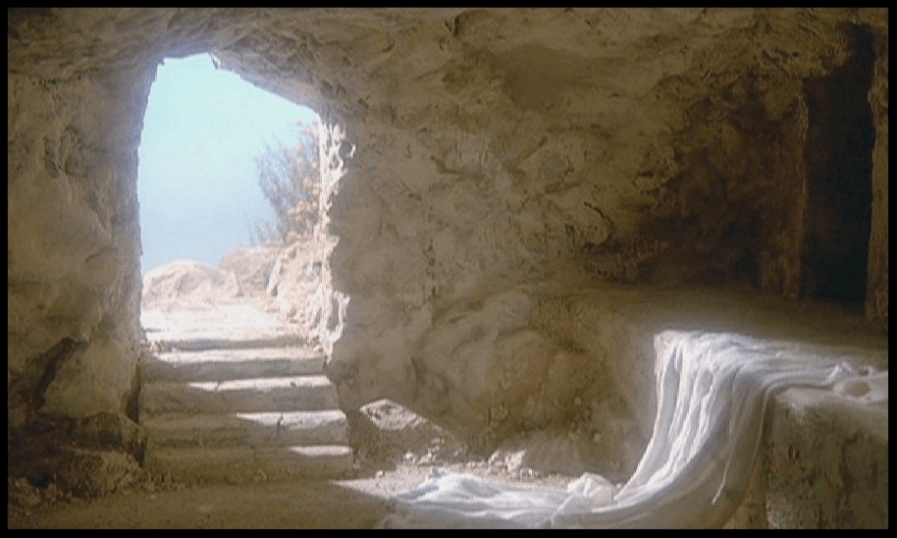
Matthew 28:1-6 “Early on Sunday morning, as the new day was dawning, Mary Magdalene and the other Mary went out to visit the tomb. 2 Suddenly there was a great earthquake! For an angel of the Lord came down from heaven, rolled aside the stone, and sat on it. 3 His face shone like lightning, and his clothing was as white as snow. 4 The guards shook with fear when they saw him, and they fell into a dead faint. 5 Then the angel spoke to the women. “Don’t be afraid!” he said. “I know you are looking for Jesus, who was crucified. 6 He isn’t here! He is risen from the dead, just as he said would happen. Come, see where his body was lying.
To be empty means containing nothing; not filled or occupied. I was raised to believe that emptiness is not a good thing. Empty pantries, empty freezers, empty wallets, empty actions, and most importantly empty words (we should not say what we don’t mean; my grandfather went as far to say that we talk so much that we talk up all the talk; James Brown calls this talking loud but saying nothing).
Emptiness is generally a sign of one’s inability to fill a void. I’m implying that when something is missing, someone feels the absence but doesn’t know what to do about it. At the death of Buddha, one of his followers was left so emotionally empty, that he said, “To the end of us that began”. He was empty, on spiritual E and didn’t know if he’d ever be filled again or if anyone or anything could ever take Buddha’s place. But today, resurrection day, Easter Sunday, with billions of believers all over the world, we don’t pity our future, but we celebrate a greater level of existence! In antiquity, death was all that life had to offer. Death was the pinnacle; it was the ceiling. But when Jesus stormed out of the grave, he stripped death of its sting and demoted death from being the ceiling of life that caps our existence, to be the floor! Now we don’t fear death as if it’s our enemy, but we use death as merely a means to usher us into the blissful presence of the God who sought us, saved us and secures us in the palm of his own hand!
After an earthly ministry that was so successful that we’re still talking about it and have been positively affected by it over two thousand years later, Jesus was s executed by crucifixion on Golgotha’s skull shaped hill, on Friday. His body was encapsulated in a first century garden grave; literally a cave carved in rock, with a stone sealing the corpse of Christ from the world, for what the Roman government and the Jewish clerics hoped would be forever.
Jesus’ burial was so rushed, so hurried, that he was not properly embalmed. But thank God for women! When men are more concerned with getting finished, so they won’t disrupt their rituals, that women know how to not just get the job done but they know how to get it done right. Some women showed up with burial spices, in order to properly embalm the body of their Lord, early Sunday morning. They speculated on the way there about who’d roll the large stone away from Jesus’ grave. I like that they didn’t allow an obstacle that they didn’t know how to overcome, to stop them from arriving where they’d set their minds to go.
It’s funny how life works out sometimes. What the women were so worried about, wasn’t even a concern at all. The stone was already rolled away when they made it to the cemetery. It was God’s way of saying “Don’t worry about the stone, because what’s heavy for you is of no consequence to me. I’ll handle your light weight before you even get to it”! Thanks be to God that when we’re up twiddling our thumbs trying to figure it out, that God has already worked it out! That’s why you don’t have to worry about the heavy stones of life, and you can go to sleep tonight, because God is up working the night shift all night long!
These dear women made it to the tomb, expecting for it to be full. Full of their dead savior. Full of their dead hopes and full of their dead dreams, for him to be their messiah; their Christ; their deliverer. But when they arrived at the tomb, for once in their lives they were overwhelmed and overjoyed that something that was supposed to be full, had turned out to be empty. Maybe emptiness in this instance, isn’t such a bad thing at all. I don’t know how you feel about it, but this Easter, I’m grateful for emptiness! Just when they thought Christians were washed up and the fat lady had sung, Jesus rose from the dead, giving us all a new lease on life! Frank Sinatra/Ol’ Blue Eyes sung what I feel Jesus may have thought on getting up morning: I faced it all and I stood tall, and did it my way! Your way said the grave should be full and stay full, but I did it my way, and emptiness sealed the deal of salvation for evermore!
I’ll land this lesson when I tell you what I came say. All of that was just my introduction. Here’s the meat of this message. Late verse 5 and verse 6 says “I know you are looking for Jesus, who was crucified. 6 He isn’t here! He is risen from the dead, just as he said would happen.”
I’ve got to wrap this up so you can get to brunch, so here is my one line Easter speech: Jesus’ grave was empty, but his words are full! He meant exactly what he said, and it happened just like he said. Don’t doubt the Lord, because his word is true! He did in fact die. He did indeed fill a garden grave. But it’s EMPTY now! And because of the empty grave, we can say that his words are full of help for today, full of hope for tomorrow, and full of certainty that he lives within my heart! The application of my little Easter speech for today, is that because of the empty grave, and the fullness of Jesus’ words, our hearts should be filled with grateful commitment. I’m talking about a heart promise, that we’ll live for Jesus with all of our lives for rest of our lives!
Alive Again! This message was prepared and preached by PastorAEW for Legacy Church at Toulminville Warren U.M. of Mobile, AL on March 23, 2025.
Acts 20:7-12 New Living Translation… On the first day of the week, we gathered with the local believers to share in the Lord’s Supper. Paul was preaching to them, and since he was leaving the next day, he kept talking until midnight. 8 The upstairs room where we met was lighted with many flickering lamps. 9 As Paul spoke on and on, a young man named Eutychus, sitting on the windowsill, became very drowsy. Finally, he fell sound asleep and dropped three stories to his death below. 10 Paul went down, bent over him, and took him into his arms. “Don’t worry,” he said, “he’s alive!” 11 Then they all went back upstairs, shared in the Lord’s Supper, and ate together. Paul continued talking to them until dawn, and then he left. 12 Meanwhile, the young man was taken home alive and well, and everyone was greatly relieved.
Our text involves a point of celebration as well as a point of controversy. It is an interesting yet complex dichotomy. On one hand, for the first time in the New Testament, we find the early church celebrating the Christian Sabbath on the Lord’s Day, Saturday evening and Sunday morning; the first day of the week. On the other hand, there is controversy surrounding the inference that Paul raised someone from the dead. Luke, the author of the text was an assistant to Paul on this journey and happened to be a physician who believed that Paul indeed, had resurrected this young man from death to life.
This story is interjected after Paul’s winter in Corinth, as he was headed to Jerusalem to celebrate the festival of Pentecost. As always, Paul runs into a problem on the way, because intel has revealed a threat on Paul’s life. So, he takes a detour and ends up in Troas. Troas is a seaport city of Asia Minor, not far from ancient Troy. It was in Troas that Paul received a vision in the night, from a man of Macedonia who pleads with him to come help them by preaching the gospel. Paul accepted the invitation and now he is there in Troas for the last time. He spends one week there, with the believers encouraging them in the Lord. There’s an infectious energy that emanates from Paul and has positively affected the city. When Sunday came, there was anticipation to gather the believers, to break bread as they remembered their risen Lord, and to hear from Paul as he spoke of the faith. There seemed to be a preference among the early church, to celebrate the Lord’s day in an upper room, like Jesus and his disciples did for the last supper and like on the day of Pentecost in Acts chapter 2. It was an apartment building, on the third floor, in the evening, that the believers of Troas met, with a room filled with flickering oil lamps, to hear the word and to worship. No doubt, they crammed into the room, to hear a father of the faith. Seating must have been limited, so much so, that a young man named Eutychus sat in an open windowsill.
Brothers and sisters, it’s at this point that the story becomes dramatic. Paul preaches a sermon that lasts until midnight. He was to leave for Jerusalem the next morning and wanted to spend his remaining time with the believers; so, he packed this message with as much red meat as he could. Eutychus couldn’t fight sleep any longer, and he fell asleep in the windowsill, and then he fell out of the window. He fell asleep, and then he fell out of the window and died. These events happened at church, and the members of this Troas assembly paused church, to run downstairs, to check on a young man whose drowsiness led to his death. Paul told everyone not to panic or to worry, because he was dead, but is alive again. Eutychus could feel his heart beating, pumping blood through his veins, beneath his skin, because he was alive again. It was after this transformative and worthwhile work, that the church went back upstairs to the third floor and continued in worship until dawn. That’s the story; now let’s unpack it.
I’m absolutely convinced that this is a strange old story, but that it has significant principles for the Legacy Church to employ today; that is, if we’re to continue being a faith community who is relevant and serious about serving this present age, which is our calling to fulfill.
Make no mistake about it, the church of Jesus Christ is to be a haven of mercy. We are not a social club, nor are we elitist who act as if we’ve arrived, puffed in self-righteousness. No, we are the people of God, who were lost but he found us; we were blind but he gave us sight; we were wandering in darkness but he brought us into the marvelous light; we were refugees in need of a refuge; we were sinners but he became our savior! After all of the free and good gifts that God has given us, we must be merciful to others. From the way we talk to other people and the tone of voice we use when we talk to them, we ought to ooze mercy. The church at Troas was so merciful that even though Eutychus’ flesh literally fell, they paused their worship to do the work of the ministry, because they knew and understood that faith without works is dead.
It’s worth noting that this church is merciful because they were aware that their culture was a contributor to the young man’s condition. Dr. Luke ensured to inform us in verse 8 that the room was illumined with “many flickering lamps”. It is a fact that the fumes of oil lamps can cause headache, dizziness, nausea, and vomiting, unconsciousness, and yeah you guessed it, drowsiness. The limitations of the culture created the conditions for Eutychus/a young man who was in church on the Lord’s day to fall out of church. I hear you though; I hear you saying “But pastor out of all the people in church that day, you’re making a big deal about one young man falling out of church, when everyone else was safe in their seat”. Well ladies and gentlemen, I hear your complaint, but I’ve got a two-pronged response: one fall out is enough (Luke 15 Jesus tells of a lost sheep being found by the shepherd), and just because you’re in your seat doesn’t mean you’re not sleep (Luke 15 also records the story of the prodigal but we can’t forget about the son who stays home but has the wrong attitude)! We must be merciful, because sometimes the fumes of our culture creates and causes fallout!
It’s important to note that when they made it downstairs, that Paul wrapped him in his arms. He embraces this young man, who has fallen, fallen, and now is dead. This isn’t my point, but it’s certainly a point to ponder, that sometimes even people in church fall. Eutychus was in church, around believers, in the presence of an apostle, but he fell anyway. When people fall at Legacy Church, it is our duty to follow Paul’s paradigm/pattern to simply love on them. They don’t need our rebuke, our criticism or critique, our gossip or our judgment, but they do need our support, our concern, and our love. We are the people of God/“An Oasis of Love”, where we have faith in you becoming alive again, and we hope that you can beat the odds after you’ve fallen, and because we have no authority for condemnation we will lovingly lift you up from your fall!
After Eutychus was made alive again, the text tells us that they returned to the upper room for the study of God’s word and the worship of the God who can make you alive again. Eutychus fell down, but when he was alive again, he went back up! We all fall down, but when God allows you to feel your heart beating beneath your skin, making you feel alive again, don’t stay down, go back up! Up in the word, that tells you you’re the head and not the tail; up in the word that says you’re more than a conqueror! Go back up in the worship of the God who gave you another chance!
Energy. This story is full of energy. It’s a positive energy that is harnessed and used for the good of the kingdom of God, to restore those among us who have fallen. It’s not a matter of if we fall, but when we fall. We’re all human, subject to mistakes and bound to miss the mark. But how do we get back up when we fall? I’ve been trying to get here the entire sermon! Galatians 6:1-3 gives the answer… “Dear brothers and sisters, if another believer is overcome by some sin, you who are godly should gently and humbly help that person back onto the right path. And be careful not to fall into the same temptation yourself. Share each other’s burdens, and in this way obey the law of Christ. If you think you are too important to help someone, you are only fooling yourself. You are not that important”.
Eutychus. The name is defined to mean he who is fortunate. Brothers and sisters, we are fortunate to have each other; let’s act like it, and help each other be whole, healthy and holy. None of us are so important that we negate the fact that we are in covenant with each other.
Alive again. We have the ability to affect change. We can lift others to a higher plane by the power of God’s spirit. That’s the kind of energy we need at work within our faith community. I believe in you, that God will use us, to be “An Oasis of Love” in the middle of a harsh and dry world.
Objective: With improvement in mind, we will use Acts 16 as a guide for discipleship development, to lose our restrictive view in favor of God’s unrestricted power for progress.
The Painful Profit
Acts 16:16-40 New Living Translation… One day as we were going down to the place of prayer, we met a slave girl who had a spirit that enabled her to tell the future. She earned a lot of money for her masters by telling fortunes. 17 She followed Paul and the rest of us, shouting, “These men are servants of the Most High God, and they have come to tell you how to be saved.”
18 This went on day after day until Paul got so exasperated that he turned and said to the demon within her, “I command you in the name of Jesus Christ to come out of her.” And instantly it left her.
19 Her masters’ hopes of wealth were now shattered, so they grabbed Paul and Silas and dragged them before the authorities at the marketplace. 20 “The whole city is in an uproar because of these Jews!” they shouted to the city officials. 21 “They are teaching customs that are illegal for us Romans to practice.”
22 A mob quickly formed against Paul and Silas, and the city officials ordered them stripped and beaten with wooden rods. 23 They were severely beaten, and then they were thrown into prison. The jailer was ordered to make sure they didn’t escape. 24 So the jailer put them into the inner dungeon and clamped their feet in the stocks.
25 Around midnight Paul and Silas were praying and singing hymns to God, and the other prisoners were listening. 26 Suddenly, there was a massive earthquake, and the prison was shaken to its foundations. All the doors immediately flew open, and the chains of every prisoner fell off! 27 The jailer woke up to see the prison doors wide open. He assumed the prisoners had escaped, so he drew his sword to kill himself. 28 But Paul shouted to him, “Stop! Don’t kill yourself! We are all here!”
29 The jailer called for lights and ran to the dungeon and fell down trembling before Paul and Silas. 30 Then he brought them out and asked, “Sirs, what must I do to be saved?”
31 They replied, “Believe in the Lord Jesus and you will be saved, along with everyone in your household.” 32 And they shared the word of the Lord with him and with all who lived in his household. 33 Even at that hour of the night, the jailer cared for them and washed their wounds. Then he and everyone in his household were immediately baptized. 34 He brought them into his house and set a meal before them, and he and his entire household rejoiced because they all believed in God.
35 The next morning the city officials sent the police to tell the jailer, “Let those men go!” 36 So the jailer told Paul, “The city officials have said you and Silas are free to leave. Go in peace.”
37 But Paul replied, “They have publicly beaten us without a trial and put us in prison—and we are Roman citizens. So now they want us to leave secretly? Certainly not! Let them come themselves to release us!”
38 When the police reported this, the city officials were alarmed to learn that Paul and Silas were Roman citizens. 39 So they came to the jail and apologized to them. Then they brought them out and begged them to leave the city. 40 When Paul and Silas left the prison, they returned to the home of Lydia. There they met with the believers and encouraged them once more. Then they left town.
Introduction: From a place of great pain that became profit, Horatio Gates Spafford wrote It Is Well With My Soul…
When peace, like a river, attendeth my way, When sorrows like sea billows roll; Whatever my lot, Thou hast taught me to say, It is well, it is well with my soul.
Though Satan should buffet, though trials should come, Let this blest assurance control, That Christ hath regarded my helpless estate, And hath shed His own blood for my soul.
(Refrain:) It is well (it is well), with my soul (with my soul), It is well, it is well with my soul.
Pain is the crucible of the Christian which is the passageway for meaningful ministry.
Overwhelming Observations:
Pain Is…
-Severe: II Corinthians 2:8-10
-Seasonal: II Corinthians 4:17
Profit is…
-Conversion: II Corinthians 5:17
-Community: Acts 16:40
Punchline: Serving the Lord requires us to learn how to turn a darkroom into a SONroom!
Conclusion: Philippians 2:5 “Let this mind be in you which was also in Christ Jesus…”
Objective: With improvement in mind, we will use Acts 16 as a guide for discipleship development, to lose our restrictive view in favor of God’s unrestricted power for progress.
Dealing With God’s No
Acts 16:6-10 New Living Translation… Next Paul and Silas traveled through the area of Phrygia and Galatia, because the Holy Spirit had prevented them from preaching the word in the province of Asia at that time. 7Then coming to the borders of Mysia, they headed north for the province of Bithynia, but again the Spirit of Jesus did not allow them to go there. 8So instead, they went on through Mysia to the seaport of Troas.
9That night Paul had a vision: A man from Macedonia in northern Greece was standing there, pleading with him, “Come over to Macedonia and help us!” 10So we decided to leave for Macedonia at once, having concluded that God was calling us to preach the Good News there.
Introduction: When mortal control meets divine sovereignty, there will either be humble submission or hard headed rebellion.
Overwhelming Observations:
-No doesn’t require any explanation (verses 6-8)
-No doesn’t mean cancelled, its a call (verse 9)
-No turns darkness into direction (verse 9)
-No turns potential into proclamation (verse 10)
Punchline: God’s no reveals our spiritual maturity, with the aim of toddler-like tantrums not hindering the progress of the grown-up work of the gospel.
Conclusion: No is hard to hear, but it’s helpful for who we are to become and for who will be made better because we lost our mind.
Isaiah 26:3 “You keep him in perfect peace whose mind (center/heart of you) is stayed on you, because he trusts in you.”
Objective: With improvement in mind, we will use Acts 16 as a guide for discipleship development, to lose our restrictive view in favor of God’s unrestricted power for progress.
You Were Born For This
Acts 16:1-5 New Living Translation… Paul went first to Derbe and then to Lystra, where there was a young disciple named Timothy. His mother was a Jewish believer, but his father was a Greek. 2 Timothy was well thought of by the believers in Lystra and Iconium, 3 so Paul wanted him to join them on their journey. In deference to the Jews of the area, he arranged for Timothy to be circumcised before they left, for everyone knew that his father was a Greek. 4 Then they went from town to town, instructing the believers to follow the decisions made by the apostles and elders in Jerusalem. 5 So the churches were strengthened in their faith and grew larger every day.
Introduction: Christians fully understand the precious beauty of birth, but we also understand the blessed burden of being bound to the purposes of God.
Transition: Luke, the author of our text, quickly shares a biographical sketch of who Paul meets. Verse 1 “…there was a young disciple named Timothy“.
Exposition:
-Christian legacy is strong.
ReferenceI Timothy 1:5
-Christian character is key.
-Christian progress is on the other side of pain.
Reference Acts 15:1-21
Conclusion: Timothy was mixed up, but thank God he wasn’t messed up!
Nehemiah 4:6 “So built we the wall; and all the wall was joined together unto the half thereof: for the people had a mind to work”.
Objective: To encourage disciples to be fully present in their relationship with God.
Embrace Me
John 14:6 New Living Translation… Jesus told him, “I am the way, the truth, and the life. No one can come to the Father except through me”.
Introduction: There are three Greek words to for life… bios (physical), psuche (soul), and zoe (eternal).
Transition: Zoe is the divine life of God, imputed to humanity at salvation.
Exposition: Embrace the creation, resurrection, and eternal life of Jesus Christ that is imputed and accessible to us.
–Life-giving: Creation…
Reference John 1:3-4 All things were made by him; and without him was not any thing made that was made. 4 In him was life; and the life was the light of men.
-Life-saving: Resurrection…
Reference John 11:25 Jesus said unto her, I am the resurrection, and the life: he that believeth in me, though he were dead, yet shall he live…
–Life-anchoring: Eternal…
Reference I John 5:11-12 And this is the record, that God hath given to us eternal life, and this life is in his Son. 12 He that hath the Son hath life; and he that hath not the Son of God hath not life.
Conclusion: Subtraction is not the business of our savior, but addition is!
Luke 13:6-9 NLT… Then Jesus told this story: “A man planted a fig tree in his garden and came again and again to see if there was any fruit on it, but he was always disappointed. 7Finally, he said to his gardener, ‘I’ve waited three years, and there hasn’t been a single fig! Cut it down. It’s just taking up space in the garden.’ 8“The gardener answered, ‘Sir, give it one more chance. Leave it another year, and I’ll give it special attention and plenty of fertilizer. 9If we get figs next year, fine. If not, then you can cut it down.’”
Introduction: In the wake of two national tragedies, Jesus preaches that condemnation is not the posture to assume but repentance is. When we fail to repent, we choose to perish. Reference verses 1-5
Transition: This parable of the barren fig tree is an appendix of the verses that precede it. It’s Jesus’ way of illustrating that when your focus is judgmental, critical, and damning of others, you have lost sight of your responsibility to be faithful and fruitful.
Exposition:
-The landowner’s expectation is fair but futile… verse 6
-The landowner’s evaluation is not rash but reasonable… verse 7
-The extension is granted because of the gardener’s plea for mercy and plan for grace… verse 8
Conclusion: This story is left incomplete, because it wasn’t about the tree in the first place. There is a possibility for conversion or condemnation… verse 9
Genesis 3:1-10The Message… The serpent was clever, more clever than any wild animal God had made. He spoke to the Woman: “Do I understand that God told you not to eat from any tree in the garden?” 2-3 The Woman said to the serpent, “Not at all. We can eat from the trees in the garden. It’s only about the tree in the middle of the garden that God said, ‘Don’t eat from it; don’t even touch it or you’ll die.’” 4-5 The serpent told the Woman, “You won’t die. God knows that the moment you eat from that tree, you’ll see what’s really going on. You’ll be just like God, knowing everything, ranging all the way from good to evil.” 6 When the Woman saw that the tree looked like good eating and realized what she would get out of it—she’d know everything!—she took and ate the fruit and then gave some to her husband, and he ate. 7 Immediately the two of them did “see what’s really going on”—saw themselves naked! They sewed fig leaves together as makeshift clothes for themselves. 8 When they heard the sound of God strolling in the garden in the evening breeze, the Man and his Wife hid in the trees of the garden, hid from God. 9 God called to the Man: “Where are you?” 10 He said, “I heard you in the garden and I was afraid because I was naked. And I hid.”
Introduction: Scandal is defined as an action or event regarded as morally or legally wrong and causing general public outrage.
Transition: The Christmas story is familiar to us, but the scandalous truth is something we choose ignore and deem as inappropriate for our picturesque customs.
Exposition: The scandal of Christmas is sin, which is rooted in self and that is a dilemma that demands a savior.
Conclusion: Yes, our story is scandalous but our God is the solvent for sins scarlet stain!
Luke 4:18-19 (NLT) “The Spirit of the LORD is upon me, for he has anointed me to bring Good News to the poor. He has sent me to proclaim that captives will be released, that the blind will see, that the oppressed will be set free, ¹⁹ and that the time of the LORD’s favor has come.”
Introduction: Everyone who claims Christ by faith, has been cleaned, called, and charged to share in the work of Christ.
Transition: Jesus is now a 30 year old rabbi, who is beginning his earthly ministry. He offers fresh perspective for a familiar passage.
Exposition: The issue that we are faced with this morning, is a broken world who knows the role of the church in this work, but they also know that we are slacking on the job. So, there are broken people who are telling the church of the Lord Jesus, that “I like Church, But” your work is insufficient.
-We don’t have to do this work, we get to do it!
-Serving a broken world is not about catering to the healthy, but about convalescing the sick.
-Our sharing in the work of Christ has to be grounded in humility, because we haven’t always been healthy.










 Antonie E. Walker Ministries