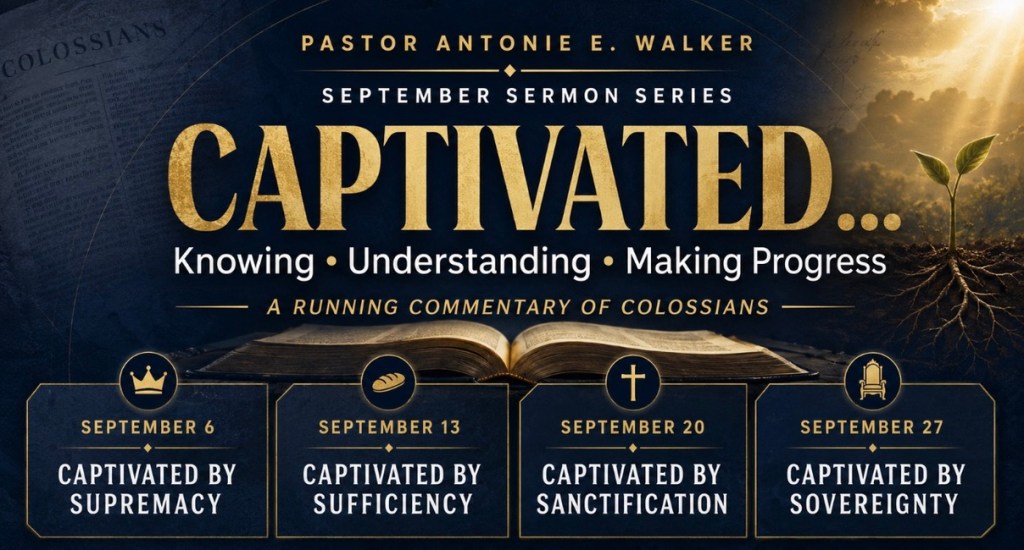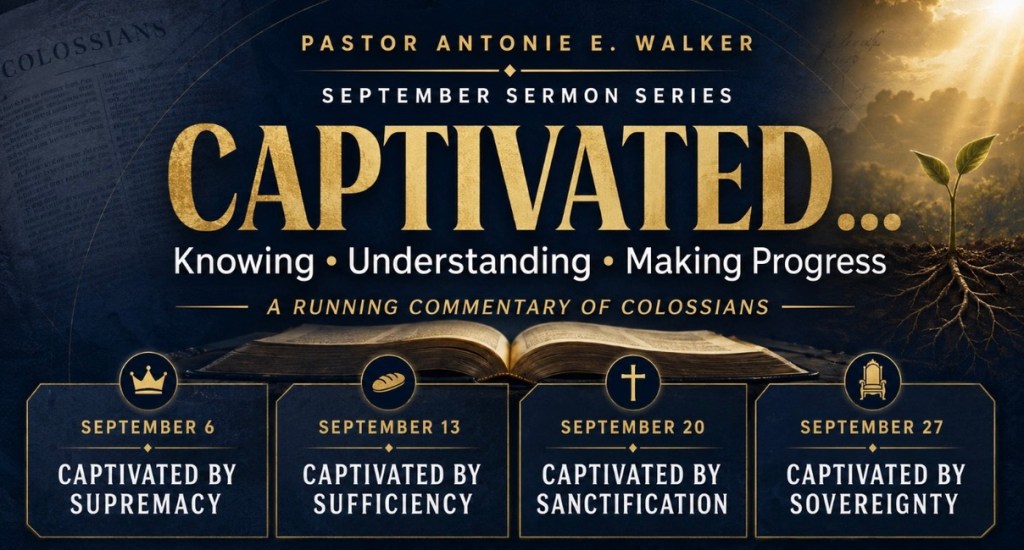
Captivated 3 of 4

Colossians 3:1-17 New Living Translation… Since you have been raised to new life with Christ, set your sights on the realities of heaven, where Christ sits in the place of honor at God’s right hand. Think about the things of heaven, not the things of earth. 3 For you died to this life, and your real life is hidden with Christ in God. 4 And when Christ, who is your life, is revealed to the whole world, you will share in all his glory.

5 So put to death the sinful, earthly things lurking within you. Have nothing to do with sexual immorality, impurity, lust, and evil desires. Don’t be greedy, for a greedy person is an idolater, worshiping the things of this world. Because of these sins, the anger of God is coming. 7 You used to do these things when your life was still part of this world. 8 But now is the time to get rid of anger, rage, malicious behavior, slander, and dirty language. 9 Don’t lie to each other, for you have stripped off your old sinful nature and all its wicked deeds. 10 Put on your new nature, and be renewed as you learn to know your Creator and become like him. 11 In this new life, it doesn’t matter if you are a Jew or a Gentile, circumcised or uncircumcised, barbaric, uncivilized, slave, or free. Christ is all that matters, and he lives in all of us.

12 Since God chose you to be the holy people he loves, you must clothe yourselves with tenderhearted mercy, kindness, humility, gentleness, and patience. 13 Make allowance for each other’s faults, and forgive anyone who offends you. Remember, the Lord forgave you, so you must forgive others. 14 Above all, clothe yourselves with love, which binds us all together in perfect harmony. 15 And let the peace that comes from Christ rule in your hearts. For as members of one body you are called to live in peace. And always be thankful.

16 Let the message about Christ, in all its richness, fill your lives. Teach and counsel each other with all the wisdom he gives. Sing psalms and hymns and spiritual songs to God with thankful hearts. 17And whatever you do or say, do it as a representative of the Lord Jesus, giving thanks through him to God the Father.
Introduction: Sanctification is the ongoing work of God in which the life we have received in Christ increasingly becomes visible in every aspect of our mortal lives. Sanctification progressively shapes us into the likeness of Christ.

Transition: Paul writes Colossians 3 to people who have already been saved, but now they must learn what salvation looks like as it integrates into their everyday lives. Christianity is not merely about getting people into heaven. It is also about getting heaven into people.

Exposition: And if we become captivated by Christ, sooner or later we must become captivated by sanctification, because you cannot continually behold Jesus without eventually being confronted by everything in you that does not look like Jesus. So…

LOOK UP — Remember Who You Are… verses 1–4

Paul says, in effect, “If you have been raised with Christ, start looking in the direction of your new life.”

The Christian life is not merely about trying harder. It is about seeing Christ more clearly. When Christ captivates the mind, He begins transforming the life.

STRIP DOWN — Remove What No Longer Belongs… verses 5–11

Once Paul establishes who we are, he becomes very direct about what must change. He says, “Put to death the sinful, earthly things lurking within you.”

Sanctification involves mortification. That is the theological word for putting sin to death. Sanctification means I stop asking only, “What do I want?” and begin asking, “What does Christ want to produce in me?”

Reference Hebrews 12:1 “…let us lay aside every weight, and the sin which doth so easily beset us, and let us run with patience the race that is set before us”!

SUIT UP — Put On What Looks Like Jesus… verses 12–17

Holiness is not simply the absence of bad behavior. It is the presence of Christlike character.

Every Christian lives beneath the shadow of a cross where Jesus absorbed a debt we could never pay.

Christians can be wounded without becoming defined by the wound.

Love is the outer garment that holds everything together.

Conclusion: Paul brings the entire passage together in one sweeping statement: “Whatever you do or say, do it as a representative of the Lord Jesus.”
Hebrews 7 Bible Study

There’s Nobody Like Jesus!

Systemic Change: The salvific system was flawed, fixed, and now we accept it by faith to be free and faithful.

Hebrews 7 New Living Translation

Lesson in a Line – Jesus does not merely help us get to God; Jesus guarantees that we can come to God.

Central Truth: Because Jesus is our eternal High Priest, our relationship with God rests on what Christ has permanently accomplished—not on what we can temporarily achieve.

INTRODUCTION — Beneath all of the theological detail of Hebrews 7, is one basic argument: Jesus is better. Why go backward when God has given you something better?

The issue is not that the old covenant was evil. The issue is that it was incomplete. It pointed forward to something/covenant (Ephesians 2:8-9) — and Someone/Christ—greater.

The Old Testament priesthood could temporarily address humanity’s problem. Jesus permanently solves it.

1. JESUS HAS A SUPERIOR PRIESTHOODverses 1–10

Melchizedek was both: King of Salem and Priest of God Most High

2. JESUS BRINGS A BETTER HOPEverses 11–19

If the Levitical priesthood could have brought humanity into complete relationship with God, why was another priest necessary? That question exposes the limitation of the old system.

3. JESUS GUARANTEES A BETTER COVENANTverses 20–28

References… When you are weak (Luke 22:31-32) and confused (John 11:21-27), even you stumble (Mark 14:27-31, 66-72; 16:7), when your faith is fragile (John 14:1-14), and when you cannot find the words to pray (John 8:1-11)—Jesus is interceding.

TRUTHS TO TAKE HOME

1. Christ is sufficient. Stop trying to add to what Jesus has already completed.

2. Christ is permanent. People change. Systems change. Seasons change. Jesus remains.

3. Christ gives us access. You do not have to hide from God because Christ has opened the way for you to approach God.

QUESTIONS TO PONDER

1. What religious habits or traditions can become substitutes for actually trusting Jesus?

2. Where am I still trying to earn from God what Christ has already made available by grace?

3. How should knowing that Jesus continually intercedes for me change the way I respond to failure, fear, and uncertainty?

Conclusion

Hebrews 7 does not simply ask us to admire Jesus. It asks us to trust Jesus completely.

Whatever season you are walking through, remember:

You have a Priest who understands.

You have a Savior who is sufficient.

You have an Advocate who is active.

You have a covenant that is better.

And you have a Christ who is forever.

Captivated 2 of 4

Colossians 1:21-2:15 New Living Translation… This includes you who were once far away from God. You were his enemies, separated from him by your evil thoughts and actions. 22 Yet now he has reconciled you to himself through the death of Christ in his physical body. As a result, he has brought you into his own presence, and you are holy and blameless as you stand before him without a single fault.

23 But you must continue to believe this truth and stand firmly in it. Don’t drift away from the assurance you received when you heard the Good News. The Good News has been preached all over the world, and I, Paul, have been appointed as God’s servant to proclaim it.

24 I am glad when I suffer for you in my body, for I am participating in the sufferings of Christ that continue for his body, the church. 25 God has given me the responsibility of serving his church by proclaiming his entire message to you. 26 This message was kept secret for centuries and generations past, but now it has been revealed to God’s people. 27 For God wanted them to know that the riches and glory of Christ are for you Gentiles, too. And this is the secret: Christ lives in you. This gives you assurance of sharing his glory.

28 So we tell others about Christ, warning everyone and teaching everyone with all the wisdom God has given us. We want to present them to God, perfect[g] in their relationship to Christ. 29 That’s why I work and struggle so hard, depending on Christ’s mighty power that works within me.

I want you to know how much I have agonized for you and for the church at Laodicea, and for many other believers who have never met me personally. I want them to be encouraged and knit together by strong ties of love. I want them to have complete confidence that they understand God’s mysterious plan, which is Christ himself. 3 In him lie hidden all the treasures of wisdom and knowledge.

4 I am telling you this so no one will deceive you with well-crafted arguments. 5 For though I am far away from you, my heart is with you. And I rejoice that you are living as you should and that your faith in Christ is strong.

6 And now, just as you accepted Christ Jesus as your Lord, you must continue to follow him. 7 Let your roots grow down into him, and let your lives be built on him. Then your faith will grow strong in the truth you were taught, and you will overflow with thankfulness.

8 Don’t let anyone capture you with empty philosophies and high-sounding nonsense that come from human thinking and from the spiritual powers of this world, rather than from Christ. For in Christ lives all the fullness of God in a human body. 10 So you also are complete through your union with Christ, who is the head over every ruler and authority.

11 When you came to Christ, you were “circumcised,” but not by a physical procedure. Christ performed a spiritual circumcision—the cutting away of your sinful nature. 12 For you were buried with Christ when you were baptized. And with him you were raised to new life because you trusted the mighty power of God, who raised Christ from the dead.

13 You were dead because of your sins and because your sinful nature was not yet cut away. Then God made you alive with Christ, for he forgave all our sins. 14 He canceled the record of the charges against us and took it away by nailing it to the cross. 15 In this way, he disarmed the spiritual rulers and authorities. He shamed them publicly by his victory over them on the cross.

Objective: To know Christ, to understand truth as opposed to heresy, and to make progress by living transformed lives.

Introduction: We live in a culture that constantly tells us, “You are not enough, and what you have is not enough.”

Transition: Paul writes to the church at Colossae because believers were being exposed to teachings that suggested Christ was significant, but that Christ was not sufficient. They were being tempted by philosophies, religious regulations, mystical ideas, traditions, and spiritual systems that implied, “Jesus is a good beginning, but if you really want to be complete, you need something more.”

The lesson is simple: Jesus is not merely enough to get us started; Jesus is enough to get us through.

Exposition:

1. CHRIST IS SUFFICIENT FOR OUR STANDING… Colossians 1:21-23

You cannot appreciate reconciliation until you understand alienation.

2. CHRIST IS SUFFICIENT FOR OUR BECOMING… Colossians 1:24-2:10

Paul is teaching us that Jesus is not just the doorway into Christianity. Jesus is the entire house.

3. CHRIST IS SUFFICIENT FOR OUR VICTORY… Colossians 2:11-15

Christianity is not rehabilitation. It is resurrection!

Conclusion: Since Christ is sufficient, I do not need another savior, another mediator, or another sacrifice. Jesus is enough!

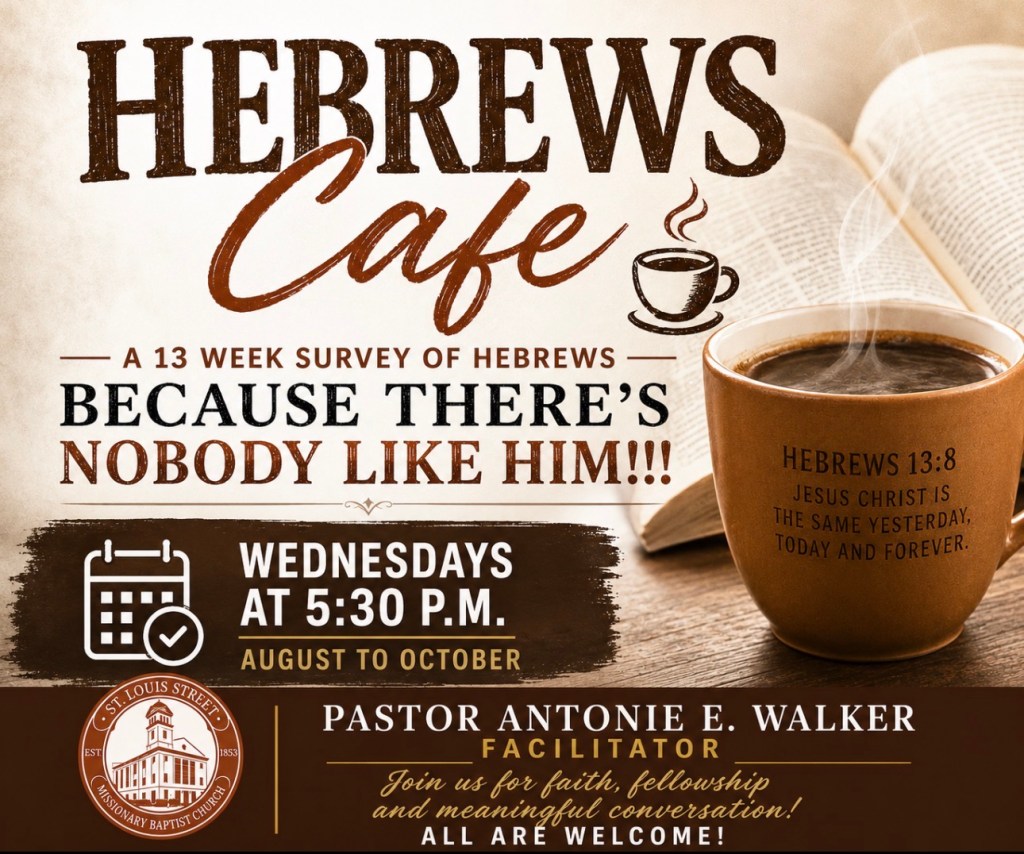
Hebrews 6 Bible Study

There’s Nobody Like Jesus!

Advice for Advancement

Hebrews 6 New Living Translation

Lesson in a Line – Because our hope is anchored in the finished work and faithful promise of Jesus Christ, believers are called to mature in faith, persevere through difficulty, and confidently trust God’s promises.

Central Truth: Christian maturity is not moving beyond Jesus; it is growing deeper in Jesus.

INTRODUCTION — FAITH WAS NEVER MEANT TO STAY IN INFANCY

Hebrews 6 opens with a challenge: “So let us stop going over the basic teachings about Christ again and again. Let us go on instead and become mature…” — Hebrews 6:1 

The writer of Hebrews is speaking to Christians who have received significant spiritual instruction but are in danger of becoming stagnant.

There is nothing wrong with being a spiritual baby when you have just been born again. The problem is staying a baby. Babies must be fed, carried, and babies must constantly be reassured.

But eventually, healthy children grow. The writer is essentially saying, You have learned the ABCs of the faith. Now it is time to start forming sentences.

God does not simply want us saved. God wants us sanctified (set apart for God’s purposes). He does not merely want conversion. He wants maturity.

That’s why Hebrews 6 moves us through three important spiritual realities:

We must progress toward maturity.

We must persevere in faithfulness.

We must possess confidence in God’s promise.

⸻I. PROGRESS TOWARD MATURITYHebrews 6:1–3

The chapter begins: “Let us go on instead and become mature in our understanding.”

Notice that the writer does not say abandon the foundations of Christianity, rather, build upon them.

You never graduate from: repentance, faith, resurrection, judgment, obedience, and dependence upon Christ.

But mature believers learn how those foundational truths shape everyday life.

Maturity means moving from information to transformation.

It is possible to know Bible verses and still be spiritually immature.

It is possible to attend Bible study and still be spiritually immature.

It is possible to have been in church for thirty years and merely have the same year of spiritual growth repeated thirty times.

Spiritual maturity is demonstrated when truth begins changing: how we respond, how we forgive, how we handle disappointment, how we manage temptation, how we treat people, and how deeply we trust God.

Paul gives a similar picture when he tells believers to grow into the likeness of Christ. Reference Romans 8:28-29

Christian maturity does not mean becoming more impressed with ourselves. It means becoming increasingly dependent upon Christ.

Question to Ponder… Where should there be greater spiritual maturity in my life today than there was a year ago?

⸻II. PERSEVERE IN FAITHFULNESSHebrews 6:4–12

This is one of the most debated passages in the New Testament.

Hebrews speaks about people who have been enlightened, experienced heavenly gifts, participated in the life of the covenant community, and yet fall away.

The warning is severe.

But we must understand why the warning is here.

The writer is addressing people tempted to abandon their confession of Christ and return to a religious system that ultimately rejects Him.

The issue is not a struggling Christian who sins, repents, and comes back to God.

If every failure meant irreversible apostasy (abandonment or renunciation of faith), Peter would have been finished after denying Jesus.

David would have been finished.

Mark would have been finished.

And frankly, all of us would be finished.

The warning concerns decisive, persistent rejection of Jesus Christ after receiving extraordinary exposure to the truth.

The agricultural illustration matters.

Hebrews says land that receives rain and produces crops receives blessing.

But land receiving the same rain and producing only thorns demonstrates that something is wrong with the soil.

The rain is the same.

The difference is the fruit.

In other words: Spiritual privilege must eventually produce spiritual fruit.

Jesus taught the same principle: You recognize a tree by its fruit (Matthew 7:16, Luke 6:44).

The author then gives readers reassurance in verse 9: “Dear friends, even though we are talking this way, we really don’t believe it applies to you.”

That sentence is critical. The warning is real, but so is the writer’s confidence in the believers.

Faithful Christians have historically interpreted Hebrews 6 differently.

Some believe the passage teaches that genuine believers can ultimately abandon salvation.

Others understand the passage as describing people who experience the blessings and influence of the Christian community without ever possessing saving faith.

Still others understand the warning itself as one of God’s means for preserving genuine believers in faith.

I believe the author to mean that those whom God truly saves, God preserves—and those God preserves will persevere.

Perseverance does not earn salvation, but it demonstrates the reality of saving faith.

Jesus is not merely able to save us initially. He is able to keep us.

Hebrews 6:11–12 gives the pastoral application.

The writer wants them to demonstrate the same diligence until the end.

Then he says: “Then you will not become spiritually dull and indifferent.”

That may be one of the greatest dangers facing believers.

Not persecution, atheism, or opposition.

Indifference is a great danger to believers. The danger of slowly reaching the place where the things of God simply do not move us anymore.

Prayer becomes casual. Worship becomes routine. Scripture becomes optional. Sin becomes tolerable. Service becomes inconvenient.

Hebrews says: Stay awake. Stay diligent. Keep trusting.

Question to Ponder… Have I become spiritually comfortable in an area where God is calling me to remain diligent?

⸻III. POSSESS CONFIDENCE IN GOD’S PROMISEHebrews 6:13–20

The chapter shifts from warning/prohibitions to tremendous encouragement/exportation.

Abraham becomes the example. God made Abraham a promise. But Abraham had to wait. That is important because faith is often lived somewhere between what God promised and when God performs it.

Hebrews says: “Then Abraham waited patiently, and he received what God had promised.”

Our problem is often not believing God can do something.

Our problem is trusting God while we wait for Him to do it.

The writer reminds us that God’s promise rests upon God’s character. God cannot lie.

Therefore our hope is not built upon: circumstances, feelings, predictions, people, politics, finances, health, or education. Our hope rests upon the character of God.

Then Hebrews gives one of the great pictures in Scripture: “This hope is a strong and trustworthy anchor for our souls.”

An anchor does not stop the storm. An anchor keeps the storm from carrying the ship away. Reference My Hope is built

Hope does not mean you never cry. Hope means your tears cannot carry you away.

Hope does not mean you never struggle. Hope means your struggle cannot separate you from Christ.

Hope does not mean circumstances cannot shake you. Hope means circumstances cannot ultimately uproot you.

And where is the anchor secured?

The text says our hope reaches behind the curtain into God’s presence, “where Jesus has already gone in before us.”

That is the gospel. Jesus is our forerunner. A forerunner does not merely enter somewhere for themselves. They enter anticipating that others will follow.

Under the Old Covenant, the high priest entered the Most Holy Place temporarily and repeatedly.

But Jesus entered God’s presence permanently on behalf of His people.

His priesthood, sacrifice, and intercession is not temporary.

Therefore our hope is not temporary.

Our anchor is not beneath us. Our anchor is above us!

We are anchored in heaven because Christ is there.

That means the security of the believer ultimately rests not in the strength of our grip upon Jesus, but in the strength of His grip upon us.

CONCLUSION — THREE COMMANDS FROM HEBREWS 6

Hebrews 6 gives us three simple instructions:

1. GROW UP.

Do not remain spiritually stagnant.

Move beyond merely knowing Christian truth toward living Christian truth.

2. HOLD ON.

Do not allow spiritual dullness, disappointment, temptation, or difficulty to pull you away from Christ.

Keep trusting. Keep serving. Keep believing.

3. LOOK AHEAD.

God keeps His promises.

Abraham waited. The saints waited. And sometimes we must wait.

But our hope has an anchor. And that anchor is Jesus Christ.

Final Question… What would change in your life this week if you truly believed your soul was securely anchored in Christ?

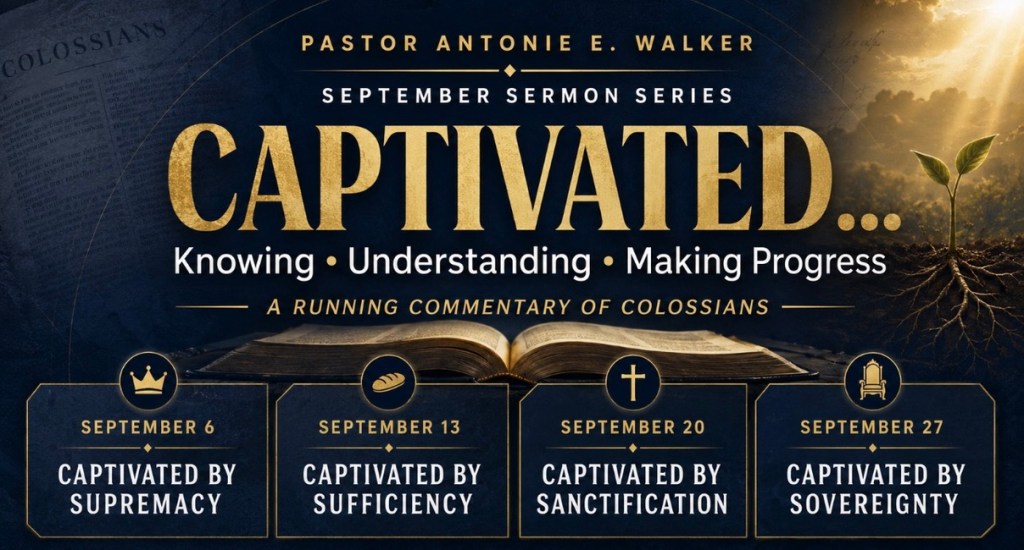
Captivated 1 of 4

Colossians 1:15-20 New Living Translation… Christ is the visible image of the invisible God. He existed before anything was created and is supreme over all creation, 16 for through him God created everything in the heavenly realms and on earth. He made the things we can see and the things we can’t see — such as thrones, kingdoms, rulers, and authorities in the unseen world. Everything was created through him and for him. 17 He existed before anything else, and he holds all creation together. 18 Christ is also the head of the church, which is his body. He is the beginning, supreme over all who rise from the dead. So he is first in everything. 19 For God in all his fullness was pleased to live in Christ, 20 and through him God reconciled everything to himself. He made peace with everything in heaven and on earth by means of Christ’s blood on the cross.

Objective: To know Christ, to understand truth as opposed to heresy, and to make progress by living transformed lives.

Introduction: To be captivated, requires the arresting of one’s attention.

Paul writes to the believers at Colossae because competing voices are attempting to reduce Jesus to simply one spiritual option among many.

Paul does not merely tell them to think more positively about Jesus. He exalts Jesus above everything, because his supremacy demands it!

Transition: Paul wants the church to understand that Jesus is not simply a part of the Christian message, because Jesus is the message.

Exposition:

-“Christ is the visible image of the invisible God.” Jesus is the exegesis/explanation of God.

-“He existed before anything was created and is supreme over all creation.” Jesus was begun before the beginning ever began to be.

-“For through him God created everything in the heavenly realms and on earth.” Everything was created through Jesus and for Jesus.

-“He existed before anything else, and he holds all creation together.” Christ does not simply create. Christ sustains.

-“Christ is also the head of the church, which is his body.” The church belongs to Jesus Christ alone. The will of Jesus must be our way!

-“The beginning, supreme over all who rise from the dead.” Because He lives, death does not have the last word.

-“For God in all his fullness was pleased to live in Christ.” Jesus is the God-man… completely human and completely divine.

-“Through him God reconciled everything to himself.” “He made peace with everything in heaven and on earth by means of Christ’s blood on the cross.”

Supreme over Creation • Supreme over the Church • Supreme over Death • Supreme in Redemption

Conclusion: Jesus must govern our lives. When you recognize His supremacy, the only appropriate response is surrender. In everything — He is supreme!”

Hebrews 5 Bible Study

There’s Nobody Like Jesus!

The Priest We Need and the People We Must Become

Hebrews 5 New Living Translation

Lesson in a Line – Because Jesus is the perfect High Priest, we can approach God with confidence—but following Him requires us to grow beyond spiritual infancy.

Central Truth: Hebrews 5 shows us that there is nobody like Jesus because He does more than represent us before God as mediator/attorney. Jesus understands our weakness, accomplished our salvation through obedient suffering, and now calls us into spiritual maturity.

Introduction: Jesus is the High Priest nobody else could ever be.

A priest stands between God and humanity. In ancient Israel, the high priest carried the responsibility of representing the people before God. He offered sacrifices. He prayed for the people. He entered holy places on their behalf.


Hebrews 5 does not merely tell us something about the position of Jesus. It tells us what kind of Savior we have—and then challenges us to consider what kind of disciples we are becoming.

Jesus understands our weaknessverses 1-4

Reference I Corinthians 15:10, Matthew 10:8

Jesus obeyed through sufferingverses 5-10

Reference Psalm 2, Psalm 110, Luke 22:42

Jesus expects us to growverses 11-14

Life Application: Jesus is presented as both our priest and pattern. He accomplished something we could never accomplish. He demonstrates the kind of obedient maturity God desires to develop within us.

-We never suffer before a Savior who cannot understand suffering.
-His obedience did not disappear when life became painful.
-Grace meets us where we are, but grace does not intend to leave us where we are.

Questions to Ponder:

  1. Am I bringing my real struggles to Him, or am I trying to appear stronger than I actually am?
  2. What has God taught me in difficulty that comfort could never have taught me?
  3. What evidence can I identify that my relationship with Christ is producing greater obedience, discernment, and maturity?

Conclusion: Since there is nobody like Him, we should refuse to remain the same while following Him.

I’m Doing the Best I Can

Proverbs 12:25 New Living Translation… Worry weighs a person down; an encouraging word cheers a person up.

Objective: The aim is to elevate our emotional awareness, so that we’re honest with ourselves in order to be honest with God.

Introduction: If we’re honest, there are moments when all we can honestly communicate to God is “Lord, I’m doing the best I can.”

Transition: The Hebrew picture is that of something bending a person’s body until they cannot stand upright anymore. They’ve been beaten into submission by the weight they carry, until it is conspicuously undeniable.

Solomon reminds us that life is often determined not merely by what happens to us, but by what is happening inside of us.

Exposition: Let’s participate in group therapy together, by allowing this proverb to stimulate progress within us.

Internal Weight Can Distort Your Direction “Worry weighs a person down…”

There is a difference between moving, and moving in the right direction.

The devil knows he doesn’t always have to destroy your life, he only has to distort your perspective.

Reference I Kings 19

Healthy Relationships Help Redirect Heavy Hearts “But an encouraging word cheers a person up.”

Isolation has become one of the greatest emotional epidemics of our generation.

Get over yourself and make some healthy connections, because healing happens in holy relationships.

Reference Proverbs 13:20, Galatians 6:2

Conclusion: What does “I’m doing the best I can” really mean? It should never become permission to remain emotionally unhealthy. Instead, it becomes an honest confession. “Lord, I’m doing the best I can – but I’m asking You to keep making my best better”!

Reference Isaiah 53:3

Hebrews 4 Bible Study

There’s Nobody Like Jesus!

Rest for the Weary – Grace for the Weak

Hebrews 4 New Living Translation

Lesson in a Line – Because there is nobody like Jesus, God’s people can rest confidently in God’s promise and come boldly to God’s presence.

Introduction:The writer has been showing us throughout Hebrews that there is nobody like Jesus. He is greater than the prophets. Greater than the angels. Greater than Moses.

Now Hebrews 4 teaches us that because Jesus is greater, He provides something nobody else can provide: Rest for God’s people and access to God’s presence.

A PROMISE FOR GOD’S PEOPLEverses 1–13 God’s invitation to rest is still valid.

Hearing Is Not the Same as Believing
God’s word becomes transformative when what we hear becomes what we believe, and what we believe becomes how we live.

What Is God’s Rest? Reference Genesis 2:2, Genesis 12:7 Those who trust Christ, enter the security of His saving work. That is true rest!

Rest Does Not Mean Inactivity There is a difference between struggling for salvation and striving because we have received salvation.

God’s Word Reveals the Heart We sometimes read Scripture intending to examine the Bible and discover that the Bible is examining us.

THE HIGH PRIEST FOR GOD’S PEOPLEverses 14–16 Jesus does not merely give us access to God. Jesus is our access to God!

Hold On to What You Believe Christian stability does not come from the absence of trouble. Christian stability comes from confidence in Christ while trouble is present.

Jesus Understands Christ’s sinlessness does not make Him less sympathetic toward us. It makes Him uniquely qualified to help us.

The Throne Has Become a Place of Grace Christians do not approach God based upon how good we have been. We approach God because Jesus is our High Priest.

Mercy and Grace Mercy means God does not give us the judgment our sins deserve. We need mercy because of what we have done. Grace is God’s undeserved favor and His sufficient help. We need grace because of what we are facing.

Bringing the text together We have a promise from God for rest that transcends time, and we have a high priest in Jesus, who grants us access to the Father.

Questions to Consider 1. What is the difference between hearing God’s Word and receiving God’s Word by faith?

2. What burden are you carrying that God may be calling you to stop controlling and start trusting Him with?

3. If Hebrews 4:16 is true, what keeps believers from approaching God boldly when they need Him most?

Unmatched Authority 4 of 4

Sustained in the Struggle

Mark 1:21-28 New Living Translation Jesus and his companions went to the town of Capernaum. When the Sabbath day came, he went into the synagogue and began to teach. 22 The people were amazed at his teaching, for he taught with real authority—quite unlike the teachers of religious law. 23 Suddenly, a man in the synagogue who was possessed by an evil spirit cried out, 24 “Why are you interfering with us, Jesus of Nazareth? Have you come to destroy us? I know who you are—the Holy One of God!”

25 But Jesus reprimanded him. “Be quiet! Come out of the man,” he ordered. 26 At that, the evil spirit screamed, threw the man into a convulsion, and then came out of him.

27 Amazement gripped the audience, and they began to discuss what had happened. “What sort of new teaching is this?” they asked excitedly. “It has such authority! Even evil spirits obey his orders!” 28 The news about Jesus spread quickly throughout the entire region of Galilee.

Introduction: Your life possesses intrinsic value, sacred worth, and inherent beauty. Reference Psalms 139:14

Transition: Parallel passage Luke 4:31-37

Exposition: As we reflect on this story, we should ponder two vital questions…

-Where is God during the struggle?

Reference Psalm 46:10, Deuteronomy 31:6

-How is grace at work in the struggle?

Reference Hebrews 4:16, Psalm 34:19

Conclusion: The anchor of this message is praise.

Reference Psalm 30:5

Hebrews 3 Bible Study

There’s Nobody Like Jesus!

Living Up

Hebrews 3 New Living Translation

Objective: to understand that Jesus upgrades our existence through partnership with Him.

Introduction: There is a difference between having more and becoming more.

The author of our text introduces tension: it’s a tragedy to enjoy what God provides while at the same time resisting what God prescribes.

Lesson in a line: Beware of a heart that welcomes God’s blessings but refuses God’s instruction.

Declaration of partnership (verses 1-6) The word “consider/think carefully” means more than casual visualization. It carries the idea of fixing one’s attention upon Jesus.

A. We have a shared calling

Reference Ephesians 2:8

Living up does not mean earning God’s acceptance. Living up means living out of the identity grace has given us.

We don’t obey so God will make us His people. We obey because, through Christ, God has made us His people.

B. Jesus is greater/better than Moses

For the original Jewish audience, Moses represented one of the greatest figures imaginable.

Moses could lead people toward the promise, but Jesus is the promise.

C. We are God’s house

This house is not the physical building where Christians assemble for worship. God’s house is God’s people. So, partnership with Jesus gives us a new understanding of our selves.

Christianity should never be reduced to asking “What can Jesus do for me?” Christian maturity asks “Since I belong to Jesus, what kind of life should I now live?”

Question to Ponder Am I following Jesus because I want His benefits, or because I have surrendered to His lordship?

Prohibition against hardened hearts (verses 7-11) After chapter 2’s warning of “don’t drift”, we receive a second warning “don’t harden your hearts”.

Reference Psalm 95:7-11

Delayed obedience has a way of becoming permanent resistance.

A. Hardening is usually gradual

This is why we take both divine sovereignty and human responsibility seriously.

B. Israel wanted God’s provision without God’s direction

The danger we must beware, a heart that welcomes God’s blessings but refuses God’s instruction.

C. The issue is the heart

In Scripture, the heart represents more than emotion. The heart is the control center of human life. It involves desire, affection, intellect, will, intention, and loyalty.

Question to Ponder What instruction from God am I currently tempted to celebrate around rather than obey?

Exhortation for Christian community (verses 12-19) The author shifts from personal warning to communal responsibility.

Biblical Christianity does not envision Christians attempting to survive spiritually alone.

A. Sin is deceptive

One reason community is necessary is that sin deceives us.

B. Encourage one another daily

Biblical encouragement is more than telling somebody “You’re doing great.” The biblical idea carries the sense of coming alongside someone—to strengthen, urge, comfort, and call them forward.

C. Partnership requires perseverance

Those whom God truly saves, God preserves—and those whom God preserves will persevere. We keep holding onto Christ because underneath our grip on Him is His grip on us.

Reference Luke 15:3-7

D. Unbelief eventually produces disobedience

Hebrews connects two primary concepts: unbelief and disobedience.

Reference Luke 6:46

Question to Ponder Who has God placed in your life who has permission to challenge your heart before it becomes hardened?

Conclusion

This text has revealed three realities to embrace…

-Partnership gives us a new identity

-Partnership requires a responsive heart

-Partnership gives us a new community

Don’t miss the conclusion of this series Sunday at 9:30 a.m.