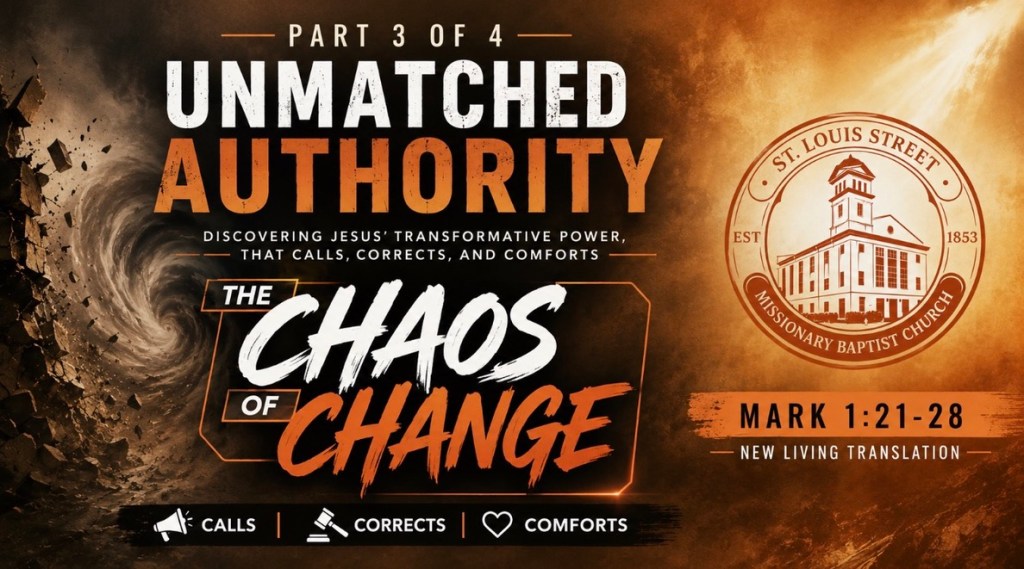
Mark 1:21-28 New Living Translation… Jesus and his companions went to the town of Capernaum. When the Sabbath day came, he went into the synagogue and began to teach. 22 The people were amazed at his teaching, for he taught with real authority—quite unlike the teachers of religious law. 23 Suddenly, a man in the synagogue who was possessed by an evil spirit cried out, 24 “Why are you interfering with us, Jesus of Nazareth? Have you come to destroy us? I know who you are—the Holy One of God!”
25But Jesus reprimanded him. “Be quiet! Come out of the man,” he ordered. 26 At that, the evil spirit screamed, threw the man into a convulsion, and then came out of him.
27 Amazement gripped the audience, and they began to discuss what had happened. “What sort of new teaching is this?” they asked excitedly. “It has such authority! Even evil spirits obey his orders!” 28 The news about Jesus spread quickly throughout the entire region of Galilee.
Introduction: Everybody wants change, but nobody wan’t to change.
Change involves alteration and adjustment. Change always costs you something.
Transition: Notice the command of Jesus produces liberation, but liberation does not initially look peaceful.
We must develop a theology (God thoughts) that are mature enough to understand that chaos is not always evidence that God is absent. Sometimes chaos occurs precisely because something that has resisted God is being displaced.
Exposition: Evil – what is morally corrupt, destructive, harmful, dishonorable, and contrary to the purposes of God.
–At that… The demon’s activity in verse 26 is not spontaneous. It is a reaction to the authoritative command of Christ in verse 25. The chaos begins because Jesus has spoken.
Reference Isaiah 55:11
Sometimes the first evidence that change has begun is not tranquility, but resistance.
–The evil spirit screamed… This type intensity is verbal resistance. The same vocabulary family gives the words of Jesus in Mark 15:37.
The gives a principle applicable beyond demon possession: What has occupied space in your life may become loud when its place in your life is threatened.
–Threw the man into a convulsion… The Greek verb here is sparaxan, from sparasso. The term describes violent physical convulsion or tearing.
Your body will tell on your soul.
The good news is that the convulsion does not cancel Christ’s command!
–And then came out of him… To be clear, the devil attempts to assert dominance, but he is not driving this narrative. Everything the spirit does happens under the shadow of an inevitable conclusion: It has to leave!
This passage is ultimately not about how powerful demons are. It is about how authoritative Jesus is. Mark does not want the church fascinated with demons, but he does want the church confident in Christ.
Conclusion: Metamorphosis is the anchor of this message. It is change so substantial that the resulting form appears dramatically different from what preceded it. Metamorphosis sometimes requires what could be labeled as conspicuous disruption for compulsory development.
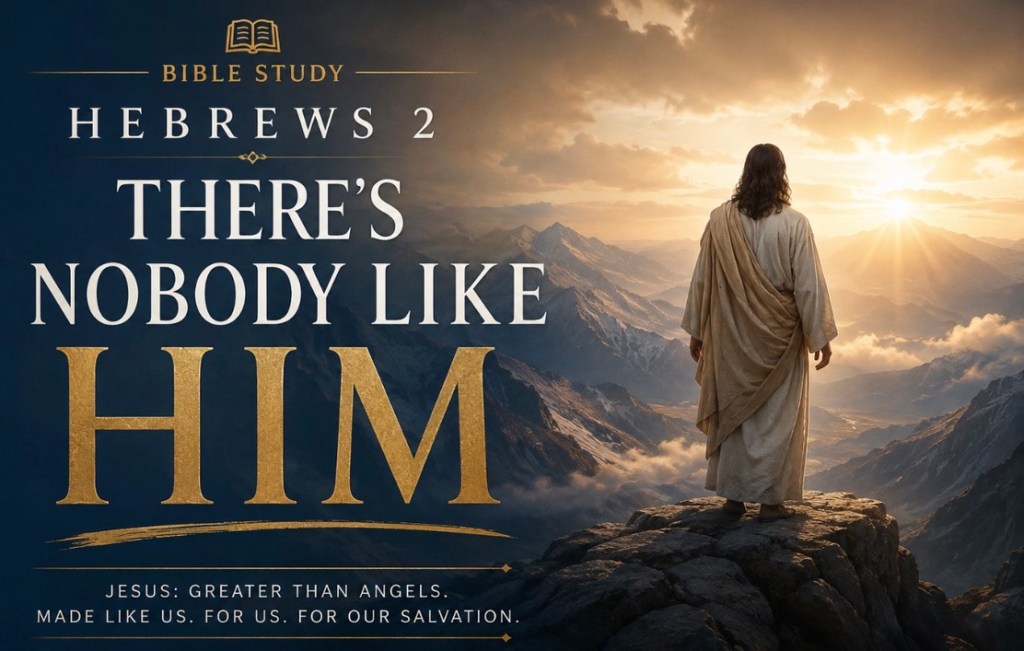
Central Truth: There is nobody like Jesus because the One who is eternally above us willingly came among us, suffered for us, defeated the enemy against us, and now faithfully helps us.
Teaching Aim: By the end of this study, participants should understand that the supremacy of Jesus is not merely demonstrated by His exalted position but also by His willingness to identify with humanity in order to accomplish our salvation.
Introduction/Review
Hebrews 1 takes us up. Hebrews 2 brings us down.
Textual Outline…
-Pay attention to Jesus — vv. 1–4
-Jesus became one of us — vv. 5–9
-Jesus suffered to save us — vv. 10–13
-Jesus defeated what enslaved us — vv. 14–18
I. THERE’S NOBODY LIKE JESUS BECAUSE HIS WORD CANNOT BE IGNORED Hebrews 2:1–4
Probing Question 1 What are some signs that a person can still be around Christian things while spiritually drifting away from Christ?
II. THERE’S NOBODY LIKE JESUS BECAUSE HE CAME DOWN TO WHERE WE ARE Hebrews 2:5–9
Reference John 1:14
III. THERE’S NOBODY LIKE JESUS BECAUSE HE SUFFERED TO SAVE US Hebrews 2:10–13
Probing Question 2 How does knowing that Jesus personally experienced suffering change the way we understand God’s presence during painful seasons?
IV. THERE’S NOBODY LIKE JESUS BECAUSE HE DEFEATED WHAT HAD US DEFEATED Hebrews 2:14–16
Reference Colossians 2:15
V. THERE’S NOBODY LIKE JESUS BECAUSE HE UNDERSTANDS AND HELPS US Hebrews 2:17–18
Jesus knows what it means to be tempted. Matthew 4:1-11
He knows rejection. Matthew 13:53-58
He knows betrayal. Mathew 26:14-16
He knows exhaustion. John 4:1-8
He knows loneliness. John 6:60-71
He knows grief. John 11:33-37
He knows suffering. John 19:17-27
Probing Question 3 Where in your life do you need to move from merely believing that Jesus understands to actually trusting Him to help you?
Takeaway… There is nobody like Jesus because nobody else could come from heaven, enter our humanity, carry our suffering, conquer our enemy, break the power of death, secure our salvation, and still be present to help us through whatever we face.
Mark 1:21-28 New Living Translation… Jesus and his companions went to the town of Capernaum. When the Sabbath day came, he went into the synagogue and began to teach. 22 The people were amazed at his teaching, for he taught with real authority—quite unlike the teachers of religious law. 23 Suddenly, a man in the synagogue who was possessed by an evil spirit cried out, 24 “Why are you interfering with us, Jesus of Nazareth? Have you come to destroy us? I know who you are—the Holy One of God!”
25But Jesus reprimanded him. “Be quiet! Come out of the man,” he ordered. 26 At that, the evil spirit screamed, threw the man into a convulsion, and then came out of him.
27 Amazement gripped the audience, and they began to discuss what had happened. “What sort of new teaching is this?” they asked excitedly. “It has such authority! Even evil spirits obey his orders!” 28 The news about Jesus spread quickly throughout the entire region of Galilee.
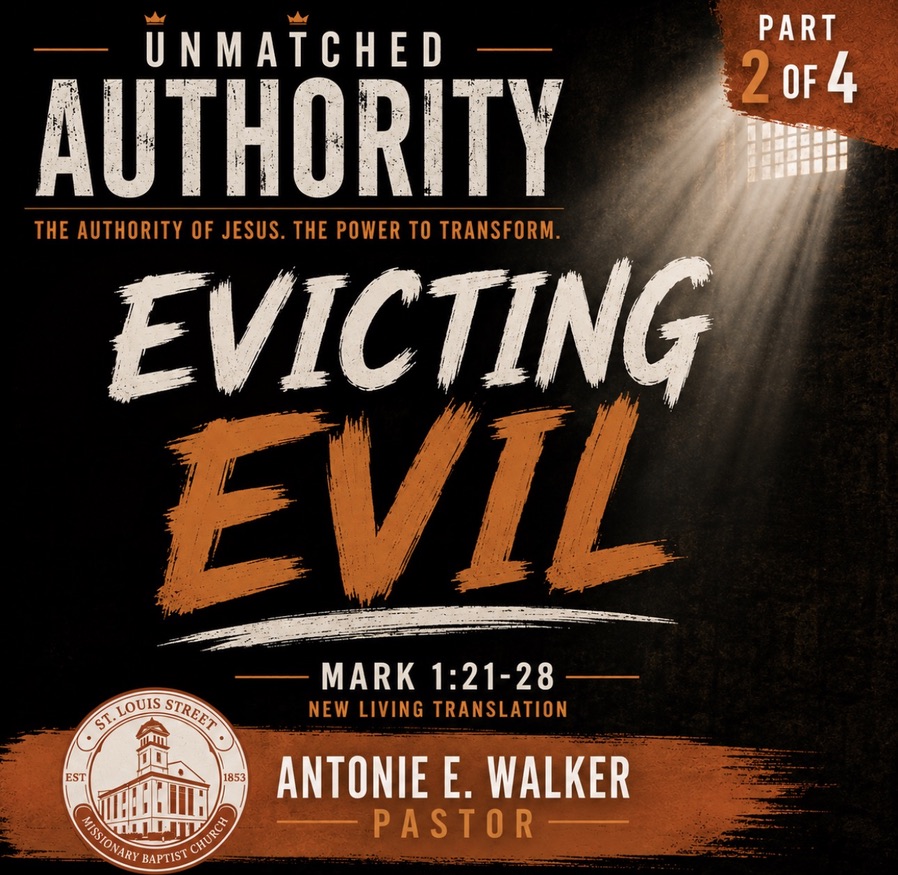
Introduction: Our text is an ancient D-Day, and the “D” stands for deliverance. This man in the synagogue is spiritually and supernaturally sick because Satan has made himself at home in his body. The enemy is not visiting or passing through. He has settled in, taken control, and made himself comfortable. He has no intention of leaving voluntarily.
Satan is profoundly immoral which is what we call evil, and he needs to be evicted/removed from the property of this man’s life by a legal authority.
Jesus’ name is strong and mighty, and Satan’s power to destroy is dwarfed in the presence of God’s power to develop!
Transition: The anchor for this message is the word process. Process is a series of strategic steps designed to achieve a goal.
The eviction of evil begins when the church embraces the centrality of Christ.
Exposition: To reprimand is the public action of a superior expressing strong disapproval toward someone who is out of order.
-Be quiet! Reference Mark 4:39
-Come out of the man.
Conclusion: Today is D-Day. It’s deliverance day for someone who is externally picturesque, but is internally incarcerated by a destructive demon.
***The notes below are PastorAEW’s teaching notes for the Hebrews Cafe.
Introduction: Hebrews is the name used by foreigners for Jews and vice versa. The author is unknown. Its recipients are believers who were growing weary.
Many of them were under pressure.
Some had lost friends.
Some had lost possessions.
Some were tempted to go back to the familiar practices of Judaism because following Jesus had become difficult.
The writer never tells them, “Try harder.”
Instead, he simply keeps lifting Jesus higher.
His argument is straightforward: If you truly see Jesus for who He is, you won’t want anyone else.
That remains the challenge today.
People are looking everywhere for peace.
They seek fulfillment in careers.
Security in money.
Identity in politics.
Validation through social media.
Hope in relationships.
Hebrews opens with one overwhelming declaration:
There’s Nobody Like Him.
Tonight, we’ll discover why.
Lesson Objective
By the end of this study I’m hoping with God’s help that you’ll understand:
Jesus is God’s final and fullest revelation.
Jesus possesses unmatched divine authority.
Jesus deserves our complete worship and trust.
I. Jesus Is God’s Final Word (Hebrews 1:1-4) Exordium: Greek literary device/rhetorical introduction to establish authority. In the original Greek, these four verses are one long run-on sentence that is powerfully poetic.
“Long ago God spoke many times and in many ways…”
The Old Testament records many ways God revealed Himself.
Through prophets
Through dreams
Through visions
Through angels
Through miracles
Through the Law
Each revelation was true.
But each one was incomplete.
Then God spoke again—not through another prophet—but through His Son.
Jesus doesn’t merely bring God’s message.
Jesus is God’s message.
John calls Him “the Word.”
If someone wants to know: What God thinks… What God loves… How God forgives… What holiness looks like… Look at Jesus.
Everything God wanted humanity to know about Himself is perfectly revealed in Christ.
Notice seven descriptions given in verses 2-3.
Jesus is: Heir of everything, Creator of the universe, Radiance of God’s glory, Exact representation of God’s nature, Sustainer of all creation, Purifier from sin, Enthroned beside the Father.
No prophet could claim all that.
No preacher can claim all that.
No denomination can claim all that.
Only Jesus!
Practical Application Whenever we’re confused about God… Start with Jesus.
Whenever we’re uncertain about God’s heart… Study Jesus.
Whenever people distort God’s character… Compare their words to Jesus.
Because there’s nobody like Him!
II. Jesus Has No Equal (Hebrews 1:4-9)
Seven Old Testament passages are quoted to prove that angels are not equal to Jesus…
Psalm 2:7 (Hebrews 1:5) – “You are my Son, today I have begotten you.”
2 Samuel 7:14 / 1 Chronicles 17:13 (Hebrews 1:5) – “I will be a Father to him and he shall be a son to me.”
Deuteronomy 32:43 or Psalm 97:7 (Hebrews 1:6) – “Let all the angels of God worship him.”
Psalm 104:4 (Hebrews 1:7) – “He makes his angels winds, and his ministers a flame of fire.”
Psalm 45:6–7 (Hebrews 1:8–9) – “Your throne, O God, is forever and ever…”
Psalm 102:25–27 (Hebrews 1:10–12) – “You, Lord, in the beginning laid the foundation of the earth…”
Psalm 110:1 (Hebrews 1:13) – “Sit at my right hand, until I make your enemies your footstool.”
The Jewish people highly respected angels. They were messengers of God. They delivered the Law. They announced miracles.
Yet Hebrews says Jesus is infinitely greater.
Notice the contrast…
Angels are servants. Jesus is the Son.
Angels worship. Jesus receives worship.
Angels are created. Jesus is Creator.
Angels obey commands. Jesus gives commands.
This chapter quotes seven Old Testament passages proving Jesus fulfills what no angel ever could.
The point isn’t that angels aren’t important.
The point is: Don’t confuse God’s servants with God’s Son.
That principle still applies today.
People admire: gifted pastors, famous authors, Christian celebrities, denominations, traditions
None deserve what belongs only to Christ. Good leaders point people to Jesus. They never replace Him.
III. Jesus’ Kingdom Never Ends (Hebrews 1:10-14)
Everything around us changes. Governments rise. Economies fluctuate. Technology becomes outdated. Our bodies age. Friendships change. Churches experience seasons.
But verses 10-12 describe Jesus differently.
Creation wears out like old clothing. Jesus never does.
The universe changes. Jesus remains.
Time changes. Jesus remains.
Culture changes. Jesus remains.
The same Christ who created the universe will outlast the universe.
That truth gives believers incredible confidence. We don’t anchor our lives to temporary things. We anchor ourselves to an eternal Savior. Our security isn’t found in circumstances. It’s found in Christ.
Practical Application When life feels uncertain… Remember that Jesus has never changed. His promises haven’t expired. His power hasn’t diminished. His grace hasn’t weakened. His throne hasn’t been challenged. There’s still nobody like Him!
Three Truths to Remember
1. Jesus reveals God perfectly. You don’t need another revelation to understand God’s heart. Look at Christ.
2. Jesus rules with unmatched authority. Nothing rivals His power. Not Satan. Not governments. Not suffering. Not death.
3. Jesus deserves wholehearted worship. The proper response to Hebrews 1 isn’t merely admiration. It’s surrender.
Three Questions to Ponder
-If someone only watched the way I live, would they conclude that Jesus is truly unrivaled in my life—or merely one priority among many?
-What substitutes am I tempted to trust more than Christ when life becomes difficult?
Examples may include: money, education, relationships, reputation, religious tradition, personal ability
-If Jesus is sustaining the entire universe (Hebrews 1:3), why do I struggle to trust Him with the circumstances of my own life?
Conclusion: Hebrews begins by answering the greatest question anyone can ask:
Who is Jesus? The answer is breathtaking.
He is God’s final Word. He is Creator. He is Sustainer. He is Savior. He is King. He is worshiped by angels. He reigns forever. He never changes.
The writer of Hebrews doesn’t simply ask us to admire Jesus. He calls us to trust Him, worship Him, and refuse every substitute. The more clearly we see Christ, the less attractive everything else becomes.
That’s why the theme of Hebrews can be summed up in one unforgettable declaration:
Mark 1:21-28 New Living Translation… Jesus and his companions went to the town of Capernaum. When the Sabbath day came, he went into the synagogue and began to teach. 22 The people were amazed at his teaching, for he taught with real authority—quite unlike the teachers of religious law.
23 Suddenly, a man in the synagogue who was possessed by an evil spirit cried out, 24 “Why are you interfering with us, Jesus of Nazareth? Have you come to destroy us? I know who you are—the Holy One of God!”
25 But Jesus reprimanded him. “Be quiet! Come out of the man,” he ordered. 26 At that, the evil spirit screamed, threw the man into a convulsion, and then came out of him.
27 Amazement gripped the audience, and they began to discuss what had happened. “What sort of new teaching is this?” they asked excitedly. “It has such authority! Even evil spirits obey his orders!” 28 The news about Jesus spread quickly throughout the entire region of Galilee.
Introduction: At the end of Jesus’ earthly ministry forty days after the resurrection, Jesus verbally proclaimed that he possessed all authority in heaven and on earth. But Mark makes it clear from the very beginning of Jesus’ ministry, that God is the ultimate, final, and definitive authority in the world, and God cannot be overruled.
Transition: Capernaum (village of comfort) is the headquarters of Jesus’ ministry. After choosing his first four disciples, he visits the synagogue (a satellite Temple) and is invited to be the guest rabbi (teacher) for the Sabbath.
While Jesus is teaching, tension arises due to the interruption of a demon possessed man… Satan comes into the sanctuary, but he efficiently rides in the attitudes, demeanors, character, emotions, and mentalities of the weak and willing.
Exposition: When Satan is present, he has a hard time keeping his mouth closed.
This demon possessed man makes three statements of affirmation concerning Jesus…
–Humanity. Jesus of Nazareth
–Authority. Have you come to destroy us? Reference James 2:19
–Divinity. I now who you are – the Holy One of God!
To prevent your ignorance of of Satan, here is a theology of Satan in three sentences…
-Satan is real.
-Satan is powerful.
-Satan is defeated! Reference Mark 15 and 16
Conclusion: The anchor word for this message is present. Satan does come into the sacred space, but it’s not for positive progress. Satan is always present for negative nourishment. Don’t sit at his table, and don’t allow him to feed you.
Objective… To plant seeds of healthy spiritual rhythms, that create a rich and fulfilling relationship with God.
I Samuel 3:1-10 New Living Translation… Meanwhile, the boy Samuel served the Lord by assisting Eli. Now in those days messages from the Lord were very rare, and visions were quite uncommon.
2 One night Eli, who was almost blind by now, had gone to bed. 3 The lamp of God had not yet gone out, and Samuel was sleeping in the Tabernacle near the Ark of God. 4 Suddenly the Lord called out, “Samuel!”
“Yes?” Samuel replied. “What is it?” 5 He got up and ran to Eli. “Here I am. Did you call me?”
“I didn’t call you,” Eli replied. “Go back to bed.” So he did.
6 Then the Lord called out again, “Samuel!” Again Samuel got up and went to Eli. “Here I am. Did you call me?” “I didn’t call you, my son,” Eli said. “Go back to bed.”
7 Samuel did not yet know the Lord because he had never had a message from the Lord before. 8 So the Lord called a third time, and once more Samuel got up and went to Eli. “Here I am. Did you call me?”
Then Eli realized it was the Lord who was calling the boy. 9 So he said to Samuel, “Go and lie down again, and if someone calls again, say, ‘Speak, Lord, your servant is listening.’” So Samuel went back to bed.
10 And the Lord came and called as before, “Samuel! Samuel!” And Samuel replied, “Speak, your servant is listening.”
Introduction: The issue of the text was not that God had stopped speaking, rather people had stopped listening.
Many believers don’t know God deeply, because they don’t truly communicate with God.
Transition: Psychologists call one of the healthiest interpersonal skills deep listening. Deep listening is more than hearing words, it is creating emotional, mental, and spiritual space for another person to be fully known.
In counseling, therapists understand something many Christians have diminished and forgotten: People don’t heal because someone had the perfect answer. People heal because someone finally listened well enough for truth to emerge.
Exposition: The thought for us to ponder is, if we’ve spent so much time trying to get God to hear us, that we’ve forgotten prayer is also about hearing Him.
Samuel teaches us that listening is holy work. Listening is transformational work. And listening is hard work that pays off.
I. Listening for God Demands Proper Placement… verses 2–4
The text says he was sleeping near the Ark of God, because location always shapes perception. You hear differently depending on where you position yourself.
Sometimes breakthrough isn’t about God speaking louder, it’s about us moving closer! Reference James 4:8
Stay close to God, so you can hear God! Reference Hebrews 10:25
II. Learning God’s Voice Requires Patient Practice… verses 4–8
Three times. Three attempts. Three failures. God’s grace is patient!
Relational proximity does not eliminate development. Reference John 11
III. Healthy Coaching Accelerates Spiritual Growth… verses 5–9
Your imperfections don’t automatically disqualify your usefulness.
Reference Proverbs 15:22
People grow faster when trusted guides help interpret experiences.
Isolation distorts discernment.
IV. Humility Unlocks Revelation… v. 10
The greatest barrier to hearing God isn’t ignorance. It’s pride. Reference I Peter 5:5
V. Listening Changes More Than Your Ears—It Changes Your Life
The remarkable thing about Samuel’s story isn’t his listening, because that is a natural rhythm God desires and deserves for us to learn and live. It was the transformation that followed listening to God’s voice that was the miracle.
Conclusion: This week, practice holy listening. Before opening your mouth in prayer, sit quietly in the presence of God. Progress begins with deep listening. Reference John 10:27
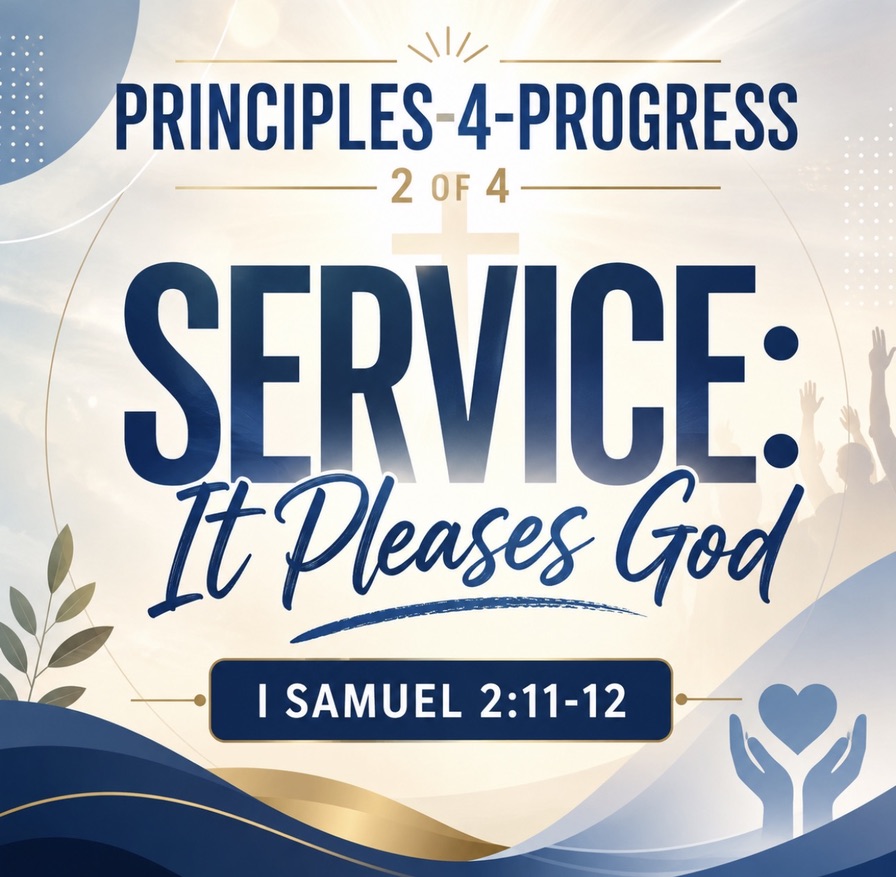
I Samuel 2:11-13a New Living Translation… Then Elkanah returned home to Ramah without Samuel. And the boy served the Lord by assisting Eli the priest. 12Now the sons of Eli were scoundrels who had no respect for the Lord 13or for their duties as priests…
Introduction: Remember that our objective in this series is to plant seeds of healthy spiritual rhythms, that create a rich and fulfilling relationship with God.
When God gave Hannah what she prayed for, Hannah gave God what she promised.
God is pleased by service, but God is not fooled by titles.
Transition: God is not merely looking for someone to stand in sacred spaces. God is looking for someone who will serve with sacred submission.
Exposition: Here are five principles for progress, s it relates to being of service which pleases…
-Service begins with surrender… verse 11
-Service is formed in ordinary faithfulness… verse 11
Reference Mark 10:43-45
-Service grows us… verse 26
-Service must be faithful, not just functional… verse 35
-Service should become more than a hobby… I Samuel 3:1
Do not allow the darkness around you to cancel the discipline within you!
Conclusion/Challenge: Make it a priority this week to do something that costs you.
God can use our ordinary faithfulness to produce extraordinary fruit!
I Samuel 1:9-18 New Living Translation… Once after a sacrificial meal at Shiloh, Hannah got up and went to pray. Eli the priest was sitting at his customary place beside the entrance of the Tabernacle. 10Hannah was in deep anguish, crying bitterly as she prayed to the Lord. 11And she made this vow: “O Lord of Heaven’s Armies, if you will look upon my sorrow and answer my prayer and give me a son, then I will give him back to you. He will be yours for his entire lifetime, and as a sign that he has been dedicated to the Lord, his hair will never be cut.”
12As she was praying to the Lord, Eli watched her. 13Seeing her lips moving but hearing no sound, he thought she had been drinking. 14“Must you come here drunk?” he demanded. “Throw away your wine!”
15 “Oh no, sir!” she replied. “I haven’t been drinking wine or anything stronger. But I am very discouraged, and I was pouring out my heart to the Lord.16Don’t think I am a wicked woman! For I have been praying out of great anguish and sorrow.”
17“In that case,” Eli said, “go in peace! May the God of Israel grant the request you have asked of him.”
18“Oh, thank you, sir!” she exclaimed. Then she went back and began to eat again, and she was no longer sad.
Introduction: The objective of this sermonic trilogy is to plant seeds of healthy spiritual rhythms that create a rich and fulfilling relationship with God.
This series is called Principles-4-Progress because progress in God requires principles that please God.
Sometimes prayer is silence because the pain is too deep for vocabulary.
Transition: It is possible to be in sacred space and still carry secret sorrow.
Exposition: Hannah’s prayer is composed of at least a trichotomy of progressive principles: pain, plea, and peace.
Hannah prays from the posture of pain.
Hannah’s plea is honest and specific.
Hannah finds peace after prayer.
Conclusion/Challenge: Whatever your heaviest weight is, bring it to God for the next five days. Because when pain becomes prayer, and prayer becomes surrender, and surrender becomes peace, you will discover that God has been working things out for you the whole time!
Introduction: Group Therapy Rules… 1) This is a no judgment, just Jesus zone. 2) Honesty with yourself and God is necessary. 3) Once you’ve made progress, you have a responsibility to to pass it on.
Most of the joylessness in our journey comes when we try to live on something instead of living for something.
Reference John 16:22, Ecclesiastes 2:10, Proverbs 17:22
Transition: Three times in the Gospels, Jesus admonishes to cheer up…
–Matthew 9:2 “Be of good cheer, son; your sins are forgiven.”
–Matthew 14:27 “Be of good cheer; it is I; do not be afraid.”
–John 16:33 “In the world you will have tribulation; but be of good cheer; I have overcome the world.”
Exposition: This 30th selection of the Psalms has at least three essential elements that help us ascertain joy for the journey: pride, prayer, and praise.
-The psalm confronts the danger of pride… verses 6-7
-The psalm teaches us the power of prayer… verses 8-10
-The psalm is an invitation to praise… verses 1-3, 11-12
Conclusion:“Sing praises to the Lord, O you his faithful ones, and give thanks to his holy name. For his anger is but for a moment; his favor is for a lifetime. Weeping may last through the night, but joy comes with the morning. (verses 4-5)”
Introduction: We have seemingly lost the capacity for the reality that God still speaks.
-God speaks in the stillness… Reference John 20:11-18, I Samuel 3:8, I Kings 19:22
-God speaks through thunder… Reference Exodus 20:18-19, Job 40:9
Transition: Whether it’s in a still small voice or in the thunder of a storm, God still speaks!
God’s voice is so majestic that we cannot limit it to any single style, shape, or sort.
Exposition: What value doe’s the voice of God possess that’s a present to us?
God’s voice brings VICTORY. “The voice of the Lord breaks the cedars; the Lord breaks the cedars of Lebanon” (verse 5). Reference Isaiah 2, Isaiah 55:11
God’s voice brings JOY. “He makes Lebanon skip like a calf, and Sirion like a young wild ox” (verse 6).
God’s voice brings FIRE. “The voice of the Lord flashes forth flames of fire” (verse 7). Reference Isaiah 1:25, Isaiah 6
God’s voice brings LIFE. Reference Luke 7:11-17, Mark 5:21-43, John 11
Conclusion:“The Lord sits enthroned over the flood; the Lord sits enthroned as king forever” (verse 10). God makes his throne above any storm, making the last great word of this selection PEACE.