

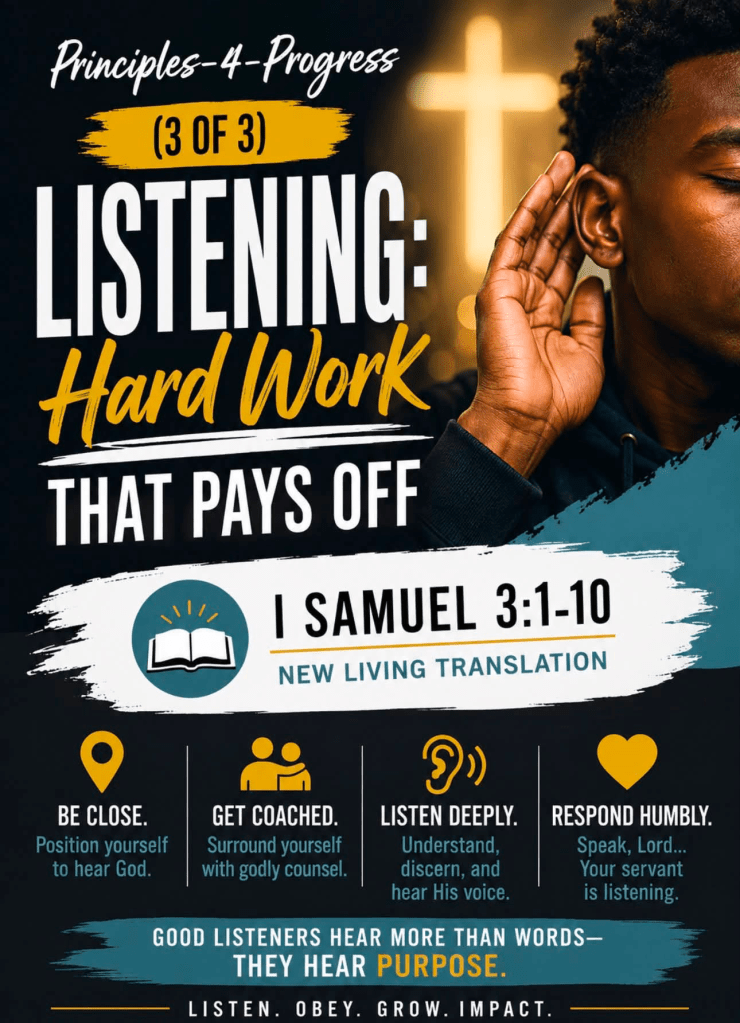
Listening: Hard Work That Pays Off
Objective… To plant seeds of healthy spiritual rhythms, that create a rich and fulfilling relationship with God.
I Samuel 3:1-10 New Living Translation… Meanwhile, the boy Samuel served the Lord by assisting Eli. Now in those days messages from the Lord were very rare, and visions were quite uncommon.
2 One night Eli, who was almost blind by now, had gone to bed. 3 The lamp of God had not yet gone out, and Samuel was sleeping in the Tabernacle near the Ark of God. 4 Suddenly the Lord called out, “Samuel!”
“Yes?” Samuel replied. “What is it?” 5 He got up and ran to Eli. “Here I am. Did you call me?”
“I didn’t call you,” Eli replied. “Go back to bed.” So he did.
6 Then the Lord called out again, “Samuel!” Again Samuel got up and went to Eli. “Here I am. Did you call me?” “I didn’t call you, my son,” Eli said. “Go back to bed.”
7 Samuel did not yet know the Lord because he had never had a message from the Lord before. 8 So the Lord called a third time, and once more Samuel got up and went to Eli. “Here I am. Did you call me?”
Then Eli realized it was the Lord who was calling the boy. 9 So he said to Samuel, “Go and lie down again, and if someone calls again, say, ‘Speak, Lord, your servant is listening.’” So Samuel went back to bed.
10 And the Lord came and called as before, “Samuel! Samuel!” And Samuel replied, “Speak, your servant is listening.”
Introduction: The issue of the text was not that God had stopped speaking, rather people had stopped listening.
Many believers don’t know God deeply, because they don’t truly communicate with God.
Transition: Psychologists call one of the healthiest interpersonal skills deep listening. Deep listening is more than hearing words, it is creating emotional, mental, and spiritual space for another person to be fully known.
In counseling, therapists understand something many Christians have diminished and forgotten: People don’t heal because someone had the perfect answer. People heal because someone finally listened well enough for truth to emerge.
Exposition: The thought for us to ponder is, if we’ve spent so much time trying to get God to hear us, that we’ve forgotten prayer is also about hearing Him.
Samuel teaches us that listening is holy work. Listening is transformational work. And listening is hard work that pays off.
I. Listening for God Demands Proper Placement… verses 2–4
The text says he was sleeping near the Ark of God, because location always shapes perception. You hear differently depending on where you position yourself.
Sometimes breakthrough isn’t about God speaking louder, it’s about us moving closer! Reference James 4:8
Stay close to God, so you can hear God! Reference Hebrews 10:25
II. Learning God’s Voice Requires Patient Practice… verses 4–8
Three times. Three attempts. Three failures. God’s grace is patient!
Relational proximity does not eliminate development. Reference John 11
III. Healthy Coaching Accelerates Spiritual Growth… verses 5–9
Your imperfections don’t automatically disqualify your usefulness.
Reference Proverbs 15:22
People grow faster when trusted guides help interpret experiences.
Isolation distorts discernment.
IV. Humility Unlocks Revelation… v. 10
The greatest barrier to hearing God isn’t ignorance. It’s pride. Reference I Peter 5:5
V. Listening Changes More Than Your Ears—It Changes Your Life
The remarkable thing about Samuel’s story isn’t his listening, because that is a natural rhythm God desires and deserves for us to learn and live. It was the transformation that followed listening to God’s voice that was the miracle.
Conclusion: This week, practice holy listening. Before opening your mouth in prayer, sit quietly in the presence of God. Progress begins with deep listening. Reference John 10:27

