Psalm 27 New Living Translation…The Lord is my light and my salvation—so why should I be afraid? The Lord is my fortress, protecting me from danger, so why should I tremble? 2 When evil people come to devour me, when my enemies and foes attack me, they will stumble and fall. 3 Though a mighty army surrounds me, my heart will not be afraid. Even if I am attacked, I will remain confident.
4 The one thing I ask of the Lord—the thing I seek most—is to live in the house of the Lord all the days of my life, delighting in the Lord’s perfections and meditating in his Temple. 5 For he will conceal me there when troubles come; he will hide me in his sanctuary. He will place me out of reach on a high rock. 6 Then I will hold my head high above my enemies who surround me. At his sanctuary I will offer sacrifices with shouts of joy, singing and praising the Lord with music.
7 Hear me as I pray, O Lord. Be merciful and answer me! 8 My heart has heard you say, “Come and talk with me.” And my heart responds, “Lord, I am coming.” 9 Do not turn your back on me. Do not reject your servant in anger. You have always been my helper. Don’t leave me now; don’t abandon me, O God of my salvation! 10 Even if my father and mother abandon me, the Lord will hold me close. 11Teach me how to live, O Lord. Lead me along the right path, for my enemies are waiting for me. 12Do not let me fall into their hands. For they accuse me of things I’ve never done; with every breath they threaten me with violence.
13Yet I am confident I will see the Lord’s goodness while I am here in the land of the living. 14Wait patiently for the Lord. Be brave and courageous. Yes, wait patiently for the Lord.
Introduction: It’s not necessary to know the context of trouble, for you to connect with the harsh reality that trouble exists and that we all experience it without you having to look for it. We don’t know when it was written, and we don’t know the circumstances or conditions it was written under.
Transition: L-I-F-E is tough. It is filled with variables that will leave you vulnerable when you aren’t in tune with the divine constant.
Exposition:
–Affirmation of confidence. verses 1-3
To be confident, evokes assurance of power, certainty of character, and faith in spite of facts.
Reference… Hebrews 13:8, Philippians 1:6
–Supplication for presence. verses 4-6
Supplication is desperate desire. David prays with a passionate push, because he’s aware that just the presence of God alone is powerful.
–Supplication for presents. verses 7-12
Mercy is a present. Mercy is when God doesn’t give us what we deserved.
–Exhortation for confidence. verses 13-14
Be confident that God is working on your behalf!
Conclusion: “Living in the presence of God, is greater than living in the absence of trouble”. ~Dr. Howard John Wesley
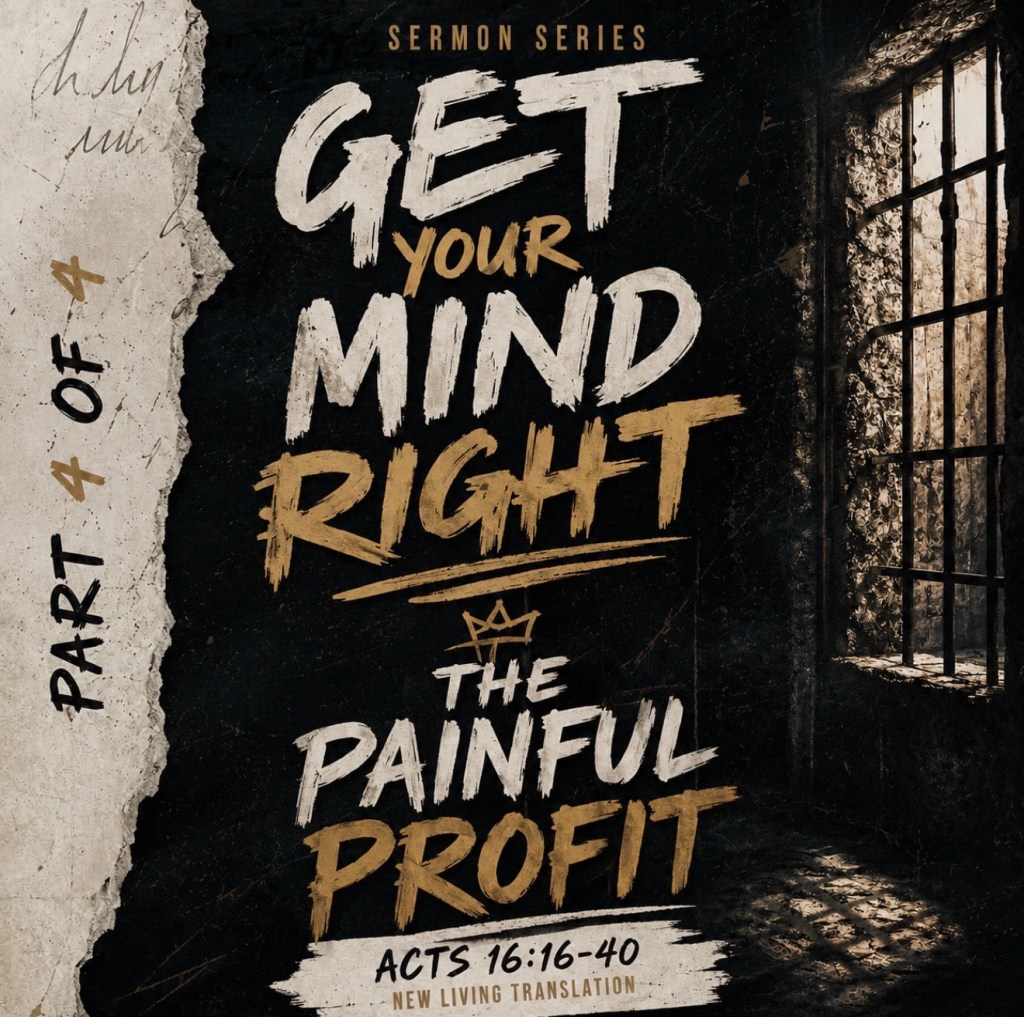
Objective: With improvement in mind, we will use Acts 16 as a guide for discipleship development, to lose our restrictive view in favor of God’s unrestricted power for progress.
The Painful Profit
Acts 16:16-40 New Living Translation… One day as we were going down to the place of prayer, we met a slave girl who had a spirit that enabled her to tell the future. She earned a lot of money for her masters by telling fortunes. 17 She followed Paul and the rest of us, shouting, “These men are servants of the Most High God, and they have come to tell you how to be saved.”
18 This went on day after day until Paul got so exasperated that he turned and said to the demon within her, “I command you in the name of Jesus Christ to come out of her.” And instantly it left her.
19 Her masters’ hopes of wealth were now shattered, so they grabbed Paul and Silas and dragged them before the authorities at the marketplace. 20 “The whole city is in an uproar because of these Jews!” they shouted to the city officials. 21 “They are teaching customs that are illegal for us Romans to practice.”
22 A mob quickly formed against Paul and Silas, and the city officials ordered them stripped and beaten with wooden rods. 23 They were severely beaten, and then they were thrown into prison. The jailer was ordered to make sure they didn’t escape. 24 So the jailer put them into the inner dungeon and clamped their feet in the stocks.
25 Around midnight Paul and Silas were praying and singing hymns to God, and the other prisoners were listening. 26 Suddenly, there was a massive earthquake, and the prison was shaken to its foundations. All the doors immediately flew open, and the chains of every prisoner fell off! 27 The jailer woke up to see the prison doors wide open. He assumed the prisoners had escaped, so he drew his sword to kill himself. 28 But Paul shouted to him, “Stop! Don’t kill yourself! We are all here!”
29 The jailer called for lights and ran to the dungeon and fell down trembling before Paul and Silas. 30 Then he brought them out and asked, “Sirs, what must I do to be saved?”
31 They replied, “Believe in the Lord Jesus and you will be saved, along with everyone in your household.” 32 And they shared the word of the Lord with him and with all who lived in his household. 33 Even at that hour of the night, the jailer cared for them and washed their wounds. Then he and everyone in his household were immediately baptized. 34 He brought them into his house and set a meal before them, and he and his entire household rejoiced because they all believed in God.
35 The next morning the city officials sent the police to tell the jailer, “Let those men go!” 36 So the jailer told Paul, “The city officials have said you and Silas are free to leave. Go in peace.”
37 But Paul replied, “They have publicly beaten us without a trial and put us in prison—and we are Roman citizens. So now they want us to leave secretly? Certainly not! Let them come themselves to release us!”
38 When the police reported this, the city officials were alarmed to learn that Paul and Silas were Roman citizens. 39 So they came to the jail and apologized to them. Then they brought them out and begged them to leave the city. 40 When Paul and Silas left the prison, they returned to the home of Lydia. There they met with the believers and encouraged them once more. Then they left town.
Introduction: From a place of great pain that became profit, Horatio Gates Spafford wrote It Is Well With My Soul…
When peace, like a river, attendeth my way, When sorrows like sea billows roll; Whatever my lot, Thou hast taught me to say, It is well, it is well with my soul.
Though Satan should buffet, though trials should come, Let this blest assurance control, That Christ hath regarded my helpless estate, And hath shed His own blood for my soul.
(Refrain:) It is well (it is well), with my soul (with my soul), It is well, it is well with my soul.
Pain is the crucible of the Christian which is the passageway for meaningful ministry.
Overwhelming Observations:
Pain Is…
–Severe: II Corinthians 2:8-10
–Seasonal: II Corinthians 4:17
Profit is…
–Conversion: II Corinthians 5:17
–Community: Acts 16:40
Punchline: Serving the Lord requires us to learn how to turn a darkroom into a SONroom!
Conclusion: “Let this mind be in you which was also in Christ Jesus…”
Objective: With improvement in mind, we will use Acts 16 as a guide for discipleship development, to lose our restrictive view in favor of God’s unrestricted power for progress.
Stick To The Plan
Introduction: One of the most frustrating facets of life’s journey, is coming to grips with the reality of unexpected shifts, twists, and turns.
Evangelism is defined as the sharing of the gospel through preaching and/or personal witness.
Overwhelming Observations: Stick to the plan, because…
–No one is exempt: don’t overlook the marginalized
References… Romans 2:11, Luke 8:1-3, Mark 16:1, Mark 16:5-7, Mark 16:9-10.
–Someone is expecting: don’t overlook the value of moments
References… Hebrews 10:25, John 5:4.
–Everyone connected is exposed: don’t overlook the power of your influence
Reference… Barna Study: Around 82% of people would consider attending church if invited by a close friend, but only about 2% of Christians actively invite friends to church, meaning a significant gap exists between potential attendees and those who are actually invited.
Punchline: When the church sits down it opens the door for comfortable communication that changes lives.
Conclusion: Sticking to the plan requires us to get our minds right, because we get stuck where we were meant to start.
Objective: With improvement in mind, we will use Acts 16 as a guide for discipleship development, to lose our restrictive view in favor of God’s unrestricted power for progress.
Dealing With God’s No
Introduction: When mortal control meets divine sovereignty, there will either be humble submission or hard headed rebellion.
Overwhelming Observations:
Reference Ephesians 3:20
-No doesn’t require any explanation (verse 6-8)
-No doesn’t mean cancelled, its a call (verse 9)
-No turns darkness into direction (verse 9)
-No turns potential into proclamation (verse 10)
Punchline: God’s no reveals our spiritual maturity, with the aim of toddler-like tantrums not hindering the progress of the grown-up work of the gospel.
Conclusion: No is hard to hear, but it’s helpful for who we are to become and for who will be made better because we committed to getting our minds right!
Objective: With improvement in mind, we will use Acts 16 as a guide for discipleship development, to lose our restrictive view in favor of God’s unrestricted power for progress.
Introduction: Christians fully understand the precious beauty of birth, but we also understand the blessed burden of being bound to the purposes of God.
Transition: Luke, the author of our text, quickly shares a biographical sketch of who Paul meets. Verse 1 “…there was a young disciple named Timothy“.
Matthew 26:26-28 New Living Translation… As they were eating, Jesus took some bread and blessed it. Then he broke it in pieces and gave it to the disciples, saying, “Take this and eat it, for this is my body.” 27 And he took a cup of wine and gave thanks to God for it. He gave it to them and said, “Each of you drink from it, 28 for this is my blood, which confirms the covenant between God and his people. It is poured out as a sacrifice to forgive the sins of many”.
Introduction: How do people know that we Christians are serious about our faith? Reference Deuteronomy 6:8
Transition: It doesn’t matter if we call this meal the eucharist (to give thanks), the Lord’s supper (an evening meal), or communion (communal meal), because the only thing that matters is that we celebrate it in remembrance of Jesus.
Exposition: This meal matters and it explains itself…
-This meal matters because it highlights that Christian communities are caring. Reference Acts 2, Matthew 23:11
-This meal matters because it reminds us of the covenant relationship we have with God. Reference Exodus 12
-This meal matters because it offers forgiveness, which frees us from guilt and shame. Reference Hebrews 9:22
Conclusion: This meal not only feeds us and unites us, but it reminds us that sin is too heavy of a load and we don’t have to carry it anymore, because Jesus paid it all!
Mark 1:21-28 New Living Translation… Jesus and his companions went to the town of Capernaum. When the Sabbath day came, he went into the synagogue and began to teach. 22 The people were amazed at his teaching, for he taught with real authority—quite unlike the teachers of religious law. 23 Suddenly, a man in the synagogue who was possessed by an evil spirit cried out, 24 “Why are you interfering with us, Jesus of Nazareth? Have you come to destroy us? I know who you are—the Holy One of God!”
25But Jesus reprimanded him. “Be quiet! Come out of the man,” he ordered. 26 At that, the evil spirit screamed, threw the man into a convulsion, and then came out of him.
27 Amazement gripped the audience, and they began to discuss what had happened. “What sort of new teaching is this?” they asked excitedly. “It has such authority! Even evil spirits obey his orders!” 28 The news about Jesus spread quickly throughout the entire region of Galilee.
Introduction: Satan is profoundly immoral which is what we call evil, and he needs to be evicted/removed from the property of this man’s life by a legal authority.
Jesus’ name is strong and mighty, and Satan’s power to destroy is dwarfed in the presence of God’s power to develop!
Transition: The anchor for this message is the word process. The eviction of evil is a process that begins when the church embraces the centrality of Christ.
Exposition: To reprimand is both public and professional.
-Be quiet! Reference Mark 4:39
-Come out of the man.
Conclusion: Today is D-Day. It’s deliverance day for someone who is externally picturesque, but is internally incarcerated by a destructive demon.
Mark 1:21-28 New Living Translation… Jesus and his companions went to the town of Capernaum. When the Sabbath day came, he went into the synagogue and began to teach. 22 The people were amazed at his teaching, for he taught with real authority—quite unlike the teachers of religious law.
23 Suddenly, a man in the synagogue who was possessed by an evil spirit cried out, 24 “Why are you interfering with us, Jesus of Nazareth? Have you come to destroy us? I know who you are—the Holy One of God!”
25 But Jesus reprimanded him. “Be quiet! Come out of the man,” he ordered. 26 At that, the evil spirit screamed, threw the man into a convulsion, and then came out of him.
27 Amazement gripped the audience, and they began to discuss what had happened. “What sort of new teaching is this?” they asked excitedly. “It has such authority! Even evil spirits obey his orders!” 28 The news about Jesus spread quickly throughout the entire region of Galilee.
Introduction: At the end of Jesus’ earthly ministry forty days after the resurrection, Jesus verbally proclaimed that he possessed all authority in heaven and on earth. But Mark makes it clear from the very beginning of Jesus’ ministry, that God is the ultimate, final, and definitive authority in the world, and God cannot be overruled.
Transition: Capernaum (village of comfort) is the headquarters of Jesus’ ministry. After choosing his first four disciples, he visits the synagogue (a satellite Temple) and is invited to be the guest rabbi (teacher) for the Sabbath.
While Jesus is teaching, tension arises due to the interruption of a demon possessed man… Satan comes into the sanctuary, but he efficiently rides in the attitudes, demeanors, character, emotions, and mentalities of the weak and willing.
Exposition: When Satan is present, he has a hard time keeping his mouth closed.
This demon possessed man makes three statements of affirmation for Jesus… –Humanity. Jesus of Nazareth
–Authority. Have you come to destroy us? Reference James 2:19
–Divinity. I now who you are – the Holy One of God!
To prevent your ignorance of of Satan, here is a theology of Satan in three sentences…
-Satan is real.
-Satan is powerful.
-Satan is defeated!
Conclusion: The anchor word for this message is present. Satan does come into the sacred space, but it’s not for positive progress. Satan is always present for negative nourishment. Don’t sit at his table, and don’t allow him to feed you.
Luke 15:11-32 New Living Translation… To illustrate the point further, Jesus told them this story: “A man had two sons. 12 The younger son told his father, ‘I want my share of your estate now before you die.’ So his father agreed to divide his wealth between his sons.
13 “A few days later this younger son packed all his belongings and moved to a distant land, and there he wasted all his money in wild living. 14 About the time his money ran out, a great famine swept over the land, and he began to starve. 15 He persuaded a local farmer to hire him, and the man sent him into his fields to feed the pigs. 16 The young man became so hungry that even the pods he was feeding the pigs looked good to him. But no one gave him anything.
17 “When he finally came to his senses, he said to himself, ‘At home even the hired servants have food enough to spare, and here I am dying of hunger! 18 I will go home to my father and say, “Father, I have sinned against both heaven and you, 19 and I am no longer worthy of being called your son. Please take me on as a hired servant.”’
20 “So he returned home to his father. And while he was still a long way off, his father saw him coming. Filled with love and compassion, he ran to his son, embraced him, and kissed him. 21 His son said to him, ‘Father, I have sinned against both heaven and you, and I am no longer worthy of being called your son.’
22 “But his father said to the servants, ‘Quick! Bring the finest robe in the house and put it on him. Get a ring for his finger and sandals for his feet. 23 And kill the calf we have been fattening. We must celebrate with a feast, 24 for this son of mine was dead and has now returned to life. He was lost, but now he is found.’ So the party began.
25 “Meanwhile, the older son was in the fields working. When he returned home, he heard music and dancing in the house, 26 and he asked one of the servants what was going on. 27 ‘Your brother is back,’ he was told, ‘and your father has killed the fattened calf. We are celebrating because of his safe return.’
28 “The older brother was angry and wouldn’t go in. His father came out and begged him, 29 but he replied, ‘All these years I’ve slaved for you and never once refused to do a single thing you told me to. And in all that time you never gave me even one young goat for a feast with my friends. 30 Yet when this son of yours comes back after squandering your money on prostitutes, you celebrate by killing the fattened calf!’
31 “His father said to him, ‘Look, dear son, you have always stayed by me, and everything I have is yours. 32 We had to celebrate this happy day. For your brother was dead and has come back to life! He was lost, but now he is found!’”
Introduction: Welcome to the clean-up crew!
Transition: Jesus was focused on driving the point home for those critical Pharisees, that heaven gets happy every time a sinner repents and returns after straying away. Reference Luke 14:1
The kingdom of God is not to be reduced to aquarium keepers, but we are fishers of men!
Exposition: Let’s reflect on three words that we need to pick-up to put the house back in order…
–Waste occurs when we’re wild
–Worth isn’t our’s to weigh
–Work isn’t a weight
Conclusion: Remember that God is the star in the entire chapter of Luke 15. The Pharisees had been complaining about characters who weren’t the stars of the show, and Jesus’ goal was to fine tune their focus.